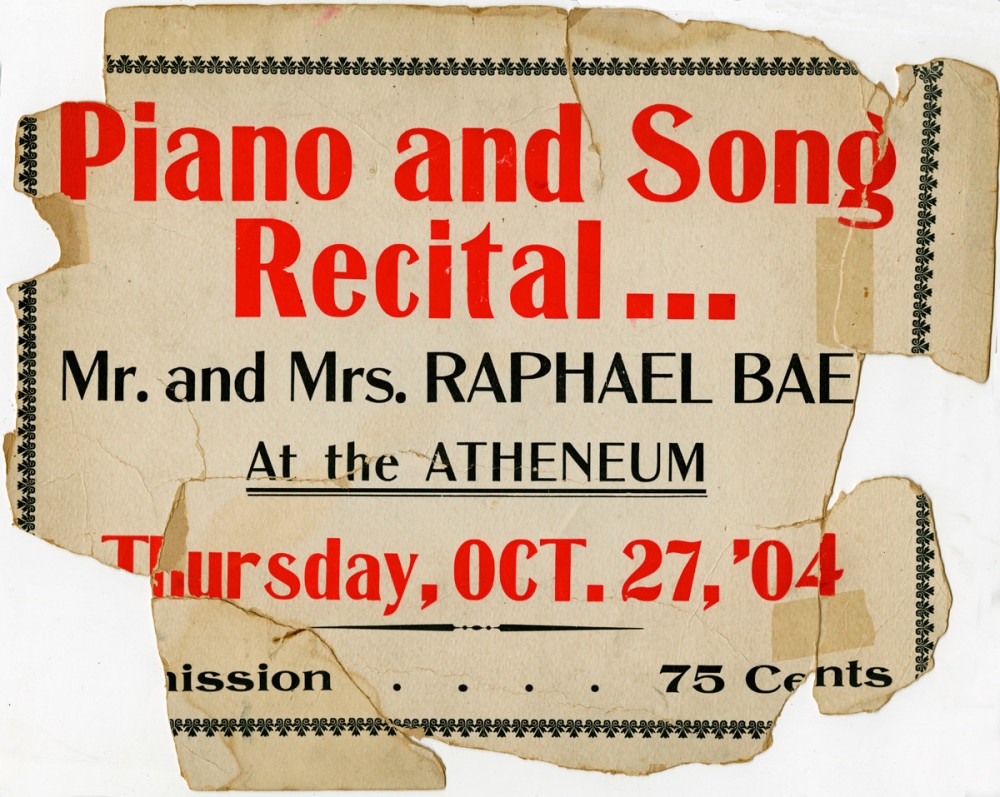
Mr. Raphael Baez, a well-respected violinist, pianist, composer, and music professor, and his wife Mrs. Mary Schoen Baez, a noted vocalist, performed together in various music halls in the city of Milwaukee since 1889. The Athenaeum, home of the Women’s Club of Wisconsin, hosted Mr. Baez and his students throughout the late nineteenth and early twentieth century. Signs like the one above would be posted throughout the city of Milwaukee in the week leading up to the performance, advertising recitals open to the general public. Baez was also one of the first Mexicans to ever call Milwaukee home. Decades later, the city would see its first Mexican immigrant community emerge when the Pfister and Vogel Leather Co. recruited laborers from Mexico in 1920 to break a strike.
Written by Sergio González, October 2013.
Produced for Wisconsin Life by Erika Janik
Raphael Baez was one of the first Mexicans to call Milwaukee home. Trained as a classical musician in Mexico, Baez was recruited to come to the United States by the C.D. Hess Opera Company in the 1880s.
Listen below to the segment from Wisconsin Public Radio’s Wisconsin Life.
Erika Janik: Look around you right now, that hat, that book, that jacket you’re wearing, what do those objects say about your history? Wisconsin 101 is a statewide history project to explore Wisconsin’s history through objects. First up is historian Sergio Gonzalez sharing a poster advertising a 1904 concert from a well-known Milwaukee musician.
Sergio González: This object is an advertisement for a music recital performed by a man named Raphael Baez and his wife, Megan Schoen Baez, and they were performing at the Athenaeum. This was around the turn of the century in 1904, and this object is special because Raphael Baez is one of the first documented Mexicans to have made his home in Milwaukee. Raphael Baez was a classically trained musician in Mexico, and he was actually recruited by a company called the C.D. Hess Opera Company. He did a tour through Mexico, and after he finished his musical tour, the company recruited him to come to Milwaukee, and he ended up making his home here in the late 1880s.
At the turn of the century, Milwaukee had a really rich and vibrant musical culture. It was actually one of the cultural hot spots for the United States. Because of their rich German heritage, they were actually known as the Deutsche Athens of America, and so posters like this would actually be scattered throughout the city any day of the week at the turn of the century.
He was trained as a violinist, he was a composer, and he eventually became the musical director of various churches throughout Milwaukee. And he was actually the first documented Mexican origin professor at Marquette University. He was a professor of music. So he came in the 1880s and the first real wave of Mexican migration didn’t happen till the 1920s so there’s actually this, this gap between when he came in the next wave. The first real wave of Mexican immigrants came in the 1920s as industrial workers. They were actually initially recruited by the Pfister & Vogel Tannery Company to work in tanneries, and eventually they settled throughout the city’s South Side throughout the 1920s.
In the Milwaukee Journal and the Milwaukee Sentinel carried advertisements of his work, and there are always glowing reviews of his concerts. He was well-respected within the musical community, and his work was, you know, his concerts were generally covered very well by the by the newspapers. You know, he decided to make his home here after touring with this opera company. So I would imagine that his experience was a pleasant one in Milwaukee, and he was able to make a life for himself and for his family to the point that he wanted to stay here for the rest of his life.
Since I’m, you know, I’m a historian, I think there’s just a certain amount of significance in identifying the community that has existed and understanding that the community has been there longer than historians might imagine, beyond the 1920s. I think this, this object is so significant because it gives, it gives us a different story for what immigration history we usually think of. Especially with Mexican immigration to the city. Baez was a middle class worker who was, he was recruited to come here as kind of a skilled worker, what we would today recognize as a highly skilled worker, and he contributed a lot to the city’s cultural history and the cultural background of the city. He trained a lot of musicians who went on to have careers within the city and within the country. And I think that within itself is a big contribution to Milwaukee’s history.
Erika Janik: That story is part of Wisconsin 101, a collaborative history project from historians, students and residents to explore our history in objects. Wisconsin Life is a co-production of Wisconsin Public Radio and Wisconsin Public Television, in partnership with the Wisconsin Humanities Council. Additional support comes from Lowell and Mary Peterson of Appleton. Find more Wisconsin life on our website, wisconsinlife.org and find us on Facebook. I’m Erika Janik.
RELATED STORIES
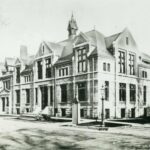
The Milwaukee Athenaeum
Milwaukee’s Early Mexican Community
Milwaukee’s Music Scene in the Late Nineteenth Century