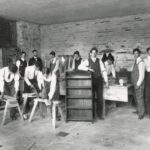
The Wilson Place Mansion front door was crafted at the turn of the twentieth century, likely by a well-known Arts and Crafts Movement blacksmith named Thomas F. Googerty. Wilson Place Mansion was the home of James Huff Stout, a lumber baron, longtime state senator, and philanthropist. Area tradition has it that the door was fashioned to honor Stout, who had founded the Stout Institute, an innovative educational institution that eventually became the University of Wisconsin-Stout.
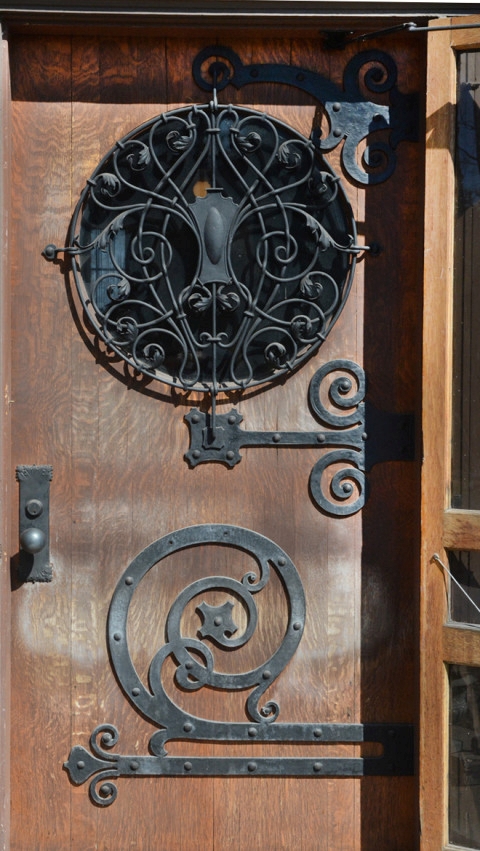
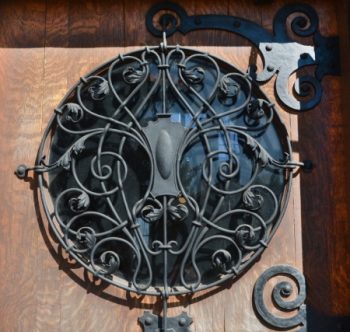
Covered with a now-weathered oak veneer, the Wilson Place door looks like a single massive slab of wood, almost 7 feet tall and 3.5 feet wide. Three large, elaborately spiraled wrought-iron hinge straps are bolted to the surface. In the upper portion of the door is a circular glass window, over 2 feet in diameter. This window is covered with a grille of spiraling and interwoven wrought-iron rods with acanthus leaves at their ends and a raised oval cartouche in the center. These motifs reflect the medieval-revival aesthetics that were a common feature of the Arts and Crafts Movement.
Written by James E. Bryan, March 2016.
This object has been featured on WPR's Wisconsin Life!
Produced for Wisconsin Life by Erika Janik and James E. Bryan.
Open the front door at Menomonie’s Wilson Place Mansion to discover a world of educational innovation and an artistic movement devoted to social responsibility and quality craftsmanship.
Listen below to the segment on Wisconsin Public Radio’s Wisconsin Life:
Erika Janik: There’s a door on Menomonie’s Wilson Place Mansion that’s more than just a door. As part of our ongoing look at the objects that tell Wisconsin’s story, Jim Bryan tells us about the social responsibility, craftsmanship and educational innovation behind that door.
Jim Bryan: I’ve been teaching history of design at UW-Stout for several years now, and take my students to Wilson Place Mansion as a field trip. And since I’d first been there, had heard the story that it was crafted by students at the Stout Institute, which is now UW-Stout, as a gift to Senator Stout and his family. And that intrigued me. It’s a large wooden door that looks very medieval. One of my colleagues said it should be on the set of The Hobbit.
We can’t prove definitively who made the door. There’s not a signature, there’s not a receipt, but I really think it’s the work of Thomas F. Googerty, who taught summer school at the Stout Institute, and was well-known, not just in the Midwest, but around the country in Arts and Crafts circles in the late-1800s/early-1900s.
James Huff Stout was, I think, the second generation of owners of Knapp, Stout & Company, which was an enormous lumber concern. According to some sources, it was the single largest white pine lumbering operation in the world in its heyday. But as 1900 approached, it was really obvious that there wasn’t a lot of timber left to harvest in this part of Wisconsin. And I think Stout felt a sense of responsibility towards his community to help prepare for the future. And I think that he saw innovative educational programs as a way to do that. They were very much interested in practical vocational skill sets, in students acquiring technical expertise to get jobs done. But they were also very interested in developing students’ intellectual capacities. They made it very clear that developing technical skills and handicraft abilities involved intellectual development. So they were always connecting those two ideas.
The door, it’s significant evidence of people who have a sense of social responsibility making an investment in innovative programs meant to uplift the community, and then the community responding with appreciation. I will say that, nowadays, many people seem to take a much more narrow philosophy as to what education is about. Many people conceive of education as simply vocational preparation and the acquisition of technical skill sets that employers are going to desire in employees. And James Huff Stout certainly understood that all of that was necessary, but he also believed that there was an aspect of enrichment and personal development that was essential.
Erika Janik: This story was part of Wisconsin 101 a collaborative project to explore Wisconsin’s history through objects. Wisconsin Life is a co-production of Wisconsin Public Radio and Wisconsin Public Television in partnership with the Wisconsin Humanities Council. Additional support comes from Lowell and Mary Peterson of Appleton. Find more Wisconsin Life on our website, wisconsinlife.org and on Facebook. I’m Erika Janek.

Wilson Place Mansion
This object is part of the Wilson Place Mansion Collection in Menomonie, Wisconsin. Research for this object essay and its related stories was supported by the museum. The author extends special thanks to: Howard S. Miller; Ron Verdon and Tim Alberg of the UW-Stout Dept. of Art and Art History; Melissa Kneeland, Executive Director of Wilson Place Museum; and Heather Stecklein, Archivist at the University of Wisconsin-Stout.