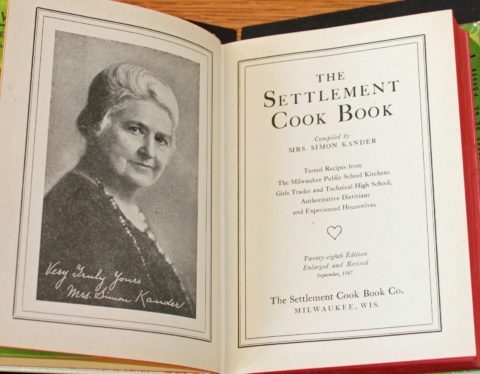
Erika Janik: Before Martha Stewart and Julia Child, there was Lizzie Kander. Ellie Gettinger from the Milwaukee Jewish Museum, tells us about the settlement cookbook and the remarkable woman behind its creation.
Ellie Gettinger: The settlement cookbook was something that I’d heard of. I grew up in Tennessee. We had one in my house, but I had no idea the history. It just was a cookbook. And I think like many people in the United States, my assumption was that the settlement house, if it was a place, was in New York. The settlement house movement in Milwaukee was founded by these German-Jewish immigrants who were looking at these new poor, Russian and Eastern European immigrants and thinking, we’ve worked really hard to be, you know, to fit in in Milwaukee. And there was this real fear that these new poor immigrants would reflect badly on the existing Jewish population that was primarily German speaking. So in the 1890s they start this as a way of developing programs.
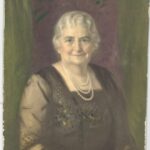
And Lizzie is a really interesting woman. She was born in the United States. Her parents were German immigrants, and Lizzie actually went to high school in the 1870s in Milwaukee, which is not, most girls aren’t getting that kind of advanced education. And so when she graduates high school, she actually is elected valedictorian in 1878 and the title of her valedictorian address is “When I Become President.” And so after she graduates, though, that’s it, you know, she’s not going to college. And the role of a woman at that point, an upper-class woman, is that you get involved in good works. And she got married, she never had children, and so she then had all of this time to think about what she should be doing in her city.
So she starts the organization. She recruits the people. She hires the staff. In like 1898 one of the things she initiates is a cooking class, and she has this sense that she’s going to teach them how to be economical American housewives. It’s not necessarily Americanizing them in the way that you think, like apple pie. You will find recipes for lots of German dishes because she is teaching them how to cook like her, an upper class German-Jewish lady. The first cookbook is published in 1901 and the impetus at first is her students are copying down recipes by hand, and it’s taking a long time, and it’s not efficient. And the other thing is that if you have something that’s published, it has more authority than something that is handwritten. And she goes to her board of directors, all men that she’s recruited, and says, I’d like to publish this cookbook. I need $18 and they immediately say, “No, we don’t think we can spare that expense, but if you find somebody to fund it, we’d be happy to share in your proceeds.” Very generous of them. So she goes to the publisher, and they develop a system where they go to most of the German-Jewish business people in the city, and they sell advertising for the cookbook. And that’s how they get their initial investment of $18 and they do a run of 1,000. They sell it for 50 cents a piece at the Boston Store.
So they sell out, but it was never the sense of, ‘this was a one time thing,’ she saw how successful this was, and immediately starts editing it. By 1907 they do their third edition, and this is really the point when it goes from being a Milwaukee regional cookbook to a national entity. You know, there are very few books that were written in Wisconsin that have the national reach that this one does. Like this is something that could have been so local, and that these women had this vision of, you know, we can take this and make this a national product.
Erika Janik: This story was produced in partnership with Wisconsin 101, a statewide collaborative project to share Wisconsin’s story in objects. Wisconsin Life is a co-production of Wisconsin Public Radio and Wisconsin Public Television in partnership with the Wisconsin Humanities Council. Additional support comes from Lowell and Mary Peterson of Appleton. Find more Wisconsin Life on our website, wisconsinlife.org and on Facebook. I’m Erika Janik.






I’m glad the settlement cookbook is still being used. It did more to make both the men and women in my family the excellent cooks/home makers they are, than anything else. It is a right of passage in my family to be given one 4 generations now), especially if one is picked to receive one of the family’s treasured (and well -used vintage copies).
We are not Jewish, but my mother had worked as a cook/housekeeper for a Jewish family in Little Rock, AR, in the late 40s, to make enough money to pay her tuition fees for Philander Smith College (LR). She’d also just married my dad, who was working as a butler (of sorts) in the same home.
To say she knew little about cooking or cleaning a kitchen, beyond what was required on a backwoods farm, would be understatement. She grew up in the hills so was used to cooking and doing laundry over an outdoor wood fire. Gas and Electric appliances with hot and cold running water were a revelation for her. But the Settlement Cookbook, along with the housekeeper and lady of the house, got her up to speed quickly.
The lady of the household gave her a copy of her own when she purchased one for her own daughter, and Mom treasured it. Years later, she got a second copy because her first fell apart (it lives in a gallon zip lock bag today), and she gifted a brand spanking new one to each one of use, as well, as we went off to college, because it has EVERYTHING in it. That was one of the beauties of the book.
I still have my mom’s 1947 and 1951 copies, my 1976 second copy (gave my first to my oldest niece as part of her wedding present package), as well as my grandmother’s copy (mom gave her one in the ’54). I’d also had a 1965 edition at one time – gave it away to a friend. I am in the process of cleaning out my mom’s home (she passed @91 a couple of years ago, and have also found a couple of 1903 facsimiles. Can’t wait to see if there are more!
You have no idea how popular the Settlement books were, outside of Wisconsin. Or maybe you do. It’s such a wonderful home cooking aid and so versatile. Thank you.
FYI: I’m old now; mine will be going to the youngest niece and her daughter when the time comes for it to pass on. She asked for them first, lol. That’s how much they matter to us, as well as to the kids and grand-kids. The book can seem a bit dated now, but we’ve got lots of notes where I’ve updated or adjusted things. Thank you again, for this wonderful resource.