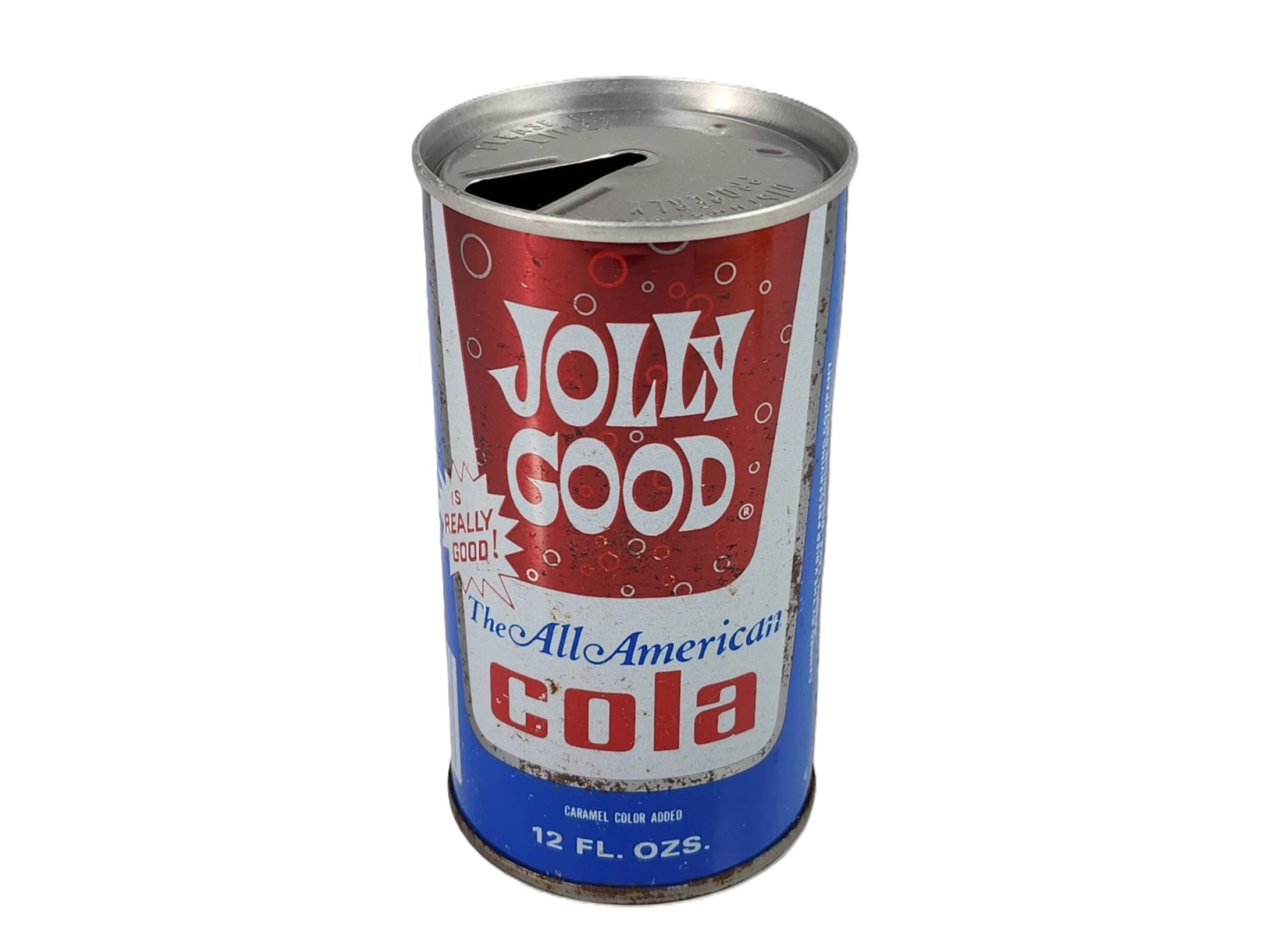
What would a Southeastern Wisconsinite grab on a hot summer day in the 1970s and 80s? Jolly Good soda of course! This local brand was celebrated as the cornerstone of cookouts, family reunions, and get-togethers.
Made in Random Lake, Wisconsin, this cola flavored can of Jolly Good soda features patriotic colors and a printed joke on the bottom of the can, differentiating Jolly Good from its competitors. Jolly Good soda was one of many brands of soda produced in Wisconsin during the twentieth century, but, unlike some other soda brands that began during prohibition, Jolly Good soda has its roots in the canned vegetables industry.
From Sauerkraut to Soda
J.B. Krier, born in Belgium, Wisconsin, created The Krier Preserving Company in 1913. Originally, the plant was built to can beets, peas, sauerkraut, corn and beans, but in 1931, Krier added soups, juices, spinach, carrots and spaghetti to their production line.[1] Krier Foods opened a second branch in Random Lake in 1935, where it remains today.

Because of Wisconsin’s extreme climate, vegetables are limited to seasonal supply, leaving canning companies with an annual period of slow production. In response, they began making Jolly Good soda to stabilize the company’s employment and revenue throughout the year.[2] During slow periods, Krier Foods could produce soda, and during busy times they could return to canning vegetables.
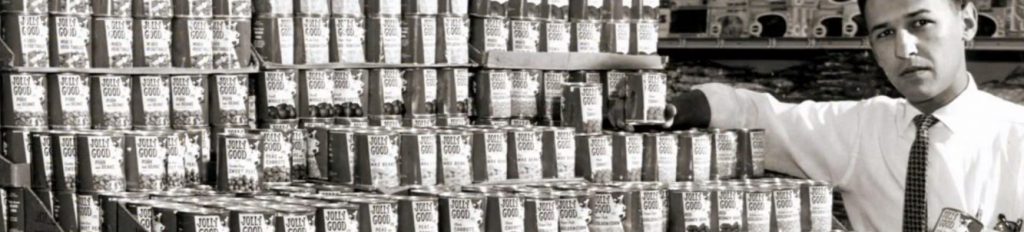
Soda proved to be a very lucrative business at the same time that national canning brands began to squeeze out small canning companies. Pressured to adapt, Krier Foods began to package cans of soda on a contract basis in the 1960s and in 1970, they launched their own soda line called Jolly Good.[3] By the 1980s, Krier Foods started focusing solely on soda production, developing almost 50 different flavors of Jolly Good by the 1990s. At their peak of production, Jolly Good distributed soda throughout the Midwestern states including Illinois, Iowa, Minnesota, and, of course, Wisconsin. Facing increased competition from Pepsi and Coca-Cola, Krier ended Jolly Good production in 2007..[4]
Jolly Good soda holds a nostalgic place in many Midwestern hearts. An overwhelming resurgence of interest in this local and unique part of Wisconsin History as well as the national success of other Wisconsin-based brands like Sprecher’s, La Croix ,and Klarbrunn, lead Krier Foods to start reproducing and selling eight of their most popular flavors in 2015. The soft launch started in only three locations, but has now expanded to over 5 different grocery store chains, various gas stations in Sheboygan and Ozaukee county as well as online on the Jolly Good website.
As of October 2018, 138,000 12-pack cases of Jolly good have been sold.[5] Now this nostalgic soft drink can be enjoyed by today’s youth as well as parents and grandparents of Southeastern Wisconsin.
Written by Anastasia Welnetz, March 2019. Edited by Trase Tracanna, December 2020.
Footnotes
[1] “Krier Company Marks 50 Years in Canning Business,” The Sheboygan Press, October 24, 1963, p. 12.
[2] Marina Affo, “Jolly Good Soda Was Dead. Then a Family Legacy Brought the Wisconsin-Made Drink Back.,” The Sheboygan Press (Sheboygan Press, October 17, 2018), https://www.sheboyganpress.com/story/news/2018/10/10/jolly-good-soda-wisconsin-made-fizzy-drinks-rebirth-family-legacy/1345375002/.
[3] Yoffie, David B., and Renee Kim. “Cola Wars Continue: Coke and Pepsi in 2010.” Harvard Business School Case 711-462, December 2010. (Revised May 2011.)
[4]Marina Affo, “Jolly Good Soda Was Dead. Then a Family Legacy Brought the Wisconsin-Made Drink Back.,” The Sheboygan Press (Sheboygan Press, October 17, 2018), https://www.sheboyganpress.com/story/news/2018/10/10/jolly-good-soda-wisconsin-made-fizzy-drinks-rebirth-family-legacy/1345375002/.
[5] Ibid
READERS RESPOND
“When I Was a child my dad had a store and purchased Jolly Good pop by the truckload and sold it in Ohio. We even brought home a couple hundred cases and loaded them in our basement and sold them to area neighbors from our back door. Memories.” – Kenny Hansel

This object has been featured on WPR's Wisconsin Life!
Produced for Wisconsin Life by Rachael Vasquez and Maureen McCollum
What would a Southeastern Wisconsinite grab on a hot summer day in the 1970s and 80s? Jolly Good soda of course!
Listen below to the segment from Wisconsin Public Radio’s Wisconsin Life.
Maureen McCollum:
What’s the first drink you think of when you hear this sound? A Pepsi Miller Lite, or was it a jolly good soda, a drink that has its roots right here in Wisconsin, a can of Jolly good soda is one of the many items included in the Wisconsin 101 project which tells the state’s history through objects. WPR’s Rachael Vasquez visited the Jolly good plant to reintroduce us to a Midwestern favorite.
Rachael Vasquez:
If you’re having trouble remembering Jolly Good, maybe this will ring a bell:
Period Advertisement:
The next time you’re in a food store buying cola, root beer, orange, or any flavored soda, take a good look at the price. I mean, a really good look. At Jolly Good, we believe in quality, but we also believe in value. We want you to get your money’s worth.
Rachael Vasquez:
Jolly Good was beloved by Midwesterners in its heyday. Krier Foods started the brand in the 1970s in Belgium, Wisconsin, but after decades of filling fridges across the region, competition from the big soda companies edged them out. They sold the last case of Jolly Good in 2007, but then 2013 rolled around and an uncle and his nephew had an idea.
John Rassel:
The term craft became very popular in the beer industry. Was there some opportunity for us to to play off that niche?
Rachael Vasquez:
That’s John Rassel, the nephew of the pair and now the President of Krier Foods. His uncle, Bruce Krier, headed the company before him.
John Rassel:
He was the one that really propelled Jolly Good to what it was.
Rachael Vasquez:
The two talked about if they could relaunch the brand and how it would work. Soon enough, they had a shot at putting it back on store shelves.
John Rassel:
So we just decided to make a small batch and see what happens.
Rachael Vasquez:
Rassel says their first big win was getting Jolly Good into Piggly Wiggly. But before long, they were selling in retailers like Woodman’s Markets, Sendik’s, and now their latest retail partner, Festival Foods.
John Rassel:
Right now, I think we would deem it as a success.
Rachael Vasquez:
Today the company makes Jolly Good at their facility in the small community of Random Lake, about 20 miles outside of Sheboygan. They produce eight regular flavors and seven diet, including cherry, cream, and the beloved “Sour Pow’r.” Before the cans get to you, each and every one goes through a special process. First, they mix it all up in a place they call the batch room.
John Rassel:
So we have two 8,000 gallon tanks, and then two 6,000 gallon tanks. So we batch the liquid back here, and then we send it out to the filler to be put into the cans.
Rachael Vasquez:
Next some tests to make sure it’s all up to snuff, and then all of that soda and a bunch of empty cans are sent to the filler room, which always smells like whatever flavor is being filled. That machine goes very fast.
John Rassel:
Seven to eight hundred cans a minute.
Rachael Vasquez:
From there, the cans are sent over to be boxed up and shrink wrapped, and then they’re put on a pallet in a warehouse with cans that go, as far as you can see, that’s where they wait before they head out to stores across Wisconsin, along with a few places in Illinois. Even with the pandemic, Russell says Jolly Good has been doing well, but he says they’ve also got ground to make up with customers they missed when they had to stop selling.
John Rassel:
If you do the math from from 2007 to 2014 when we weren’t on the shelves, we missed a generation.
Rachael Vasquez:
Russell says they have some help with that, though, from older generations who still know and love Jolly Good.
John Rassel:
Part of it is, is that those older generations remembering the brand, remembering the memories, and wanting to recreate those memories with the younger generation. It’s very impactful, you know, especially during this time.
Rachael Vasquez:
That’s where a lot of the brand’s power comes from, the nostalgia people feel for it.
John Rassel:
Whether it was camping ball games, you know, the lake house, the beach, you know, you name it. Everyone, you know, just kind of reached out, you know. I remember drinking Jolly Good.
Rachael Vasquez:
Rassel’s uncle Bruce passed away before he had a chance to see Jolly Good come to life again. He says it was important to pay homage to him and his work building Jolly Good.
John Rassel:
Hopefully he’d be proud. I think we did a pretty good job.
Maureen McCollum:
WPR’s Rachael Vasquez brought us that story on Jolly Good soda. It’s part of the Wisconsin 101 project which tells our state’s history through objects. Wisconsin Life is a co-production of Wisconsin Public Radio and PBS Wisconsin in partnership with Wisconsin Humanities, additional support comes from Lowell and Mary Peterson of Appleton. Find more Wisconsin Life at wisconsinlife.org and on Facebook. I’m Maureen McCollum.
Random Lake Area Historical Society & Museum
Research for this object was supported by the Random Lake Area Historical Society & Museum in Random Lake, Wisconsin.