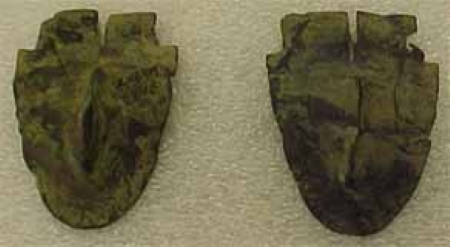
Aztalan Copper Maskettes, 1000-1200 AD. Courtesy: Milwaukee Public Museum
Found at the Aztalan archaeological site in southeastern Wisconsin, these small copper artifacts were most likely used as ornate jewelry.[1] Specifically, Mississipian people likely wore the mask-shaped copper designs as earrings. Although Native Americans seldom used metal, they sometimes used metals from the copper deposits found in the Great Lakes region to make tools and ornamental pieces like these 5.8 x 4.6 centimeter earrings. It is worth noting that in their present form the maskettes are missing the long-nosed feature seen in other masks. According to Ho-Chunk tradition, the maskette shape honors a cultural hero of the Siouan, known as Red Horn.[2]
The copper maskettes represent a complex Wisconsin culture that existed long before state lines were drawn and white settlers came to control the land. The people of Aztalan were part of the greater Mississippian society that originated from the Mississippi River Valley, spreading throughout the length of the river, and all the way to the Southeastern coast of the modern United States from the 9th-14th centuries.[3] The Aztalan-region maskettes vary in shape and size across archaeological sites along the Mississippi, indicating diversity within the Mississippian culture from Wisconsin to the Louisianan Gulf coast.
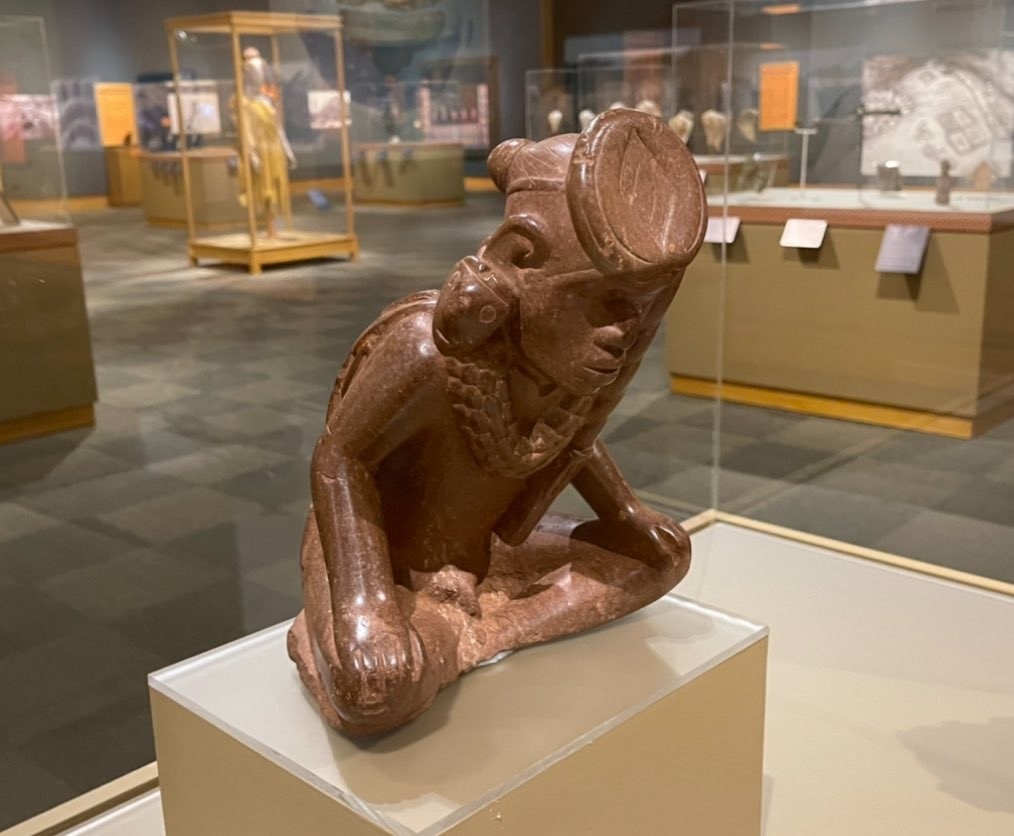
Effigy pipe bauxite sculpture of a seated male figure, known as “Resting Warrior” or “Big Boy” and identified as Morning Star or the hero Red Horn. The figure wears maskettes as ear jewelry. Found at the Spiro Site in Le Flore County, Oklahoma. Now in the Nelson-Atkins Museum of Art at the University of Arkansas (#47-2-1).
FOOTNOTES
[1] Arik Scapellato, “The Native Copper of Aztalan,” University of Wisconsin-Milwaukee Undergraduate Research Symposium, April 2020. https://sites.uwm.edu/undergrad-research-symposium/2020/04/17/the-native-copper-of-aztalan/.
[2] Kurt A. Sampson, “Wisconsin Outpost,” Milwaukee Public Museum. Accessed December 18, 2020, http://www.mpm.edu/research-collections/anthropology/online-collections-research/aztalan-collection/wisconsin-outpost.
[3] Adam King, “Mississippian Period: Overview.” New Georgia Encyclopedia. 29 September 2020. Accessed 15 December 2020. https://www.georgiaencyclopedia.org/articles/history-archaeology/mississippian-period-overview/
Nature & Culture Museum of Wisconsin
This object is part of the archaeology collection of the Nature & Culture Museum of Wisconsin in Milwaukee.