The Babcock butterfat test, developed at the University of Wisconsin, provided a simple, accurate, and inexpensive way to assess milk quality and to pay farmers accordingly. By improving standards and rewarding the best milk producers, the Babcock butterfat test transformed the dairy industry in the United States and set Wisconsin firmly on the path to becoming America’s Dairy State.
Change in a Cheese Box
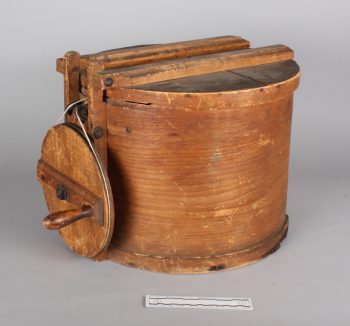
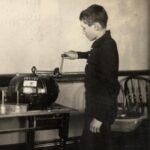
Seldom has such a transformative technology arrived in such an unassuming package. This Babcock tester was built inside a standard, 16-inch diameter cheese box. There is no manufacturer’s information, either on the tester or on the printed instructions tacked to the inside of the lid. Aside from the central shaft and a few nails and bolts, it has no metal parts. The simple construction techniques would have required little investment and no specialized manufacturing tools.
The almost “do it yourself” quality of this Babcock tester reflects Stephen Babcock’s desire to share his work freely, for the benefit of the dairy industry. Babcock refused to patent his invention, preferring that any interested parties could build, use, modify or share it without facing a financial barrier.
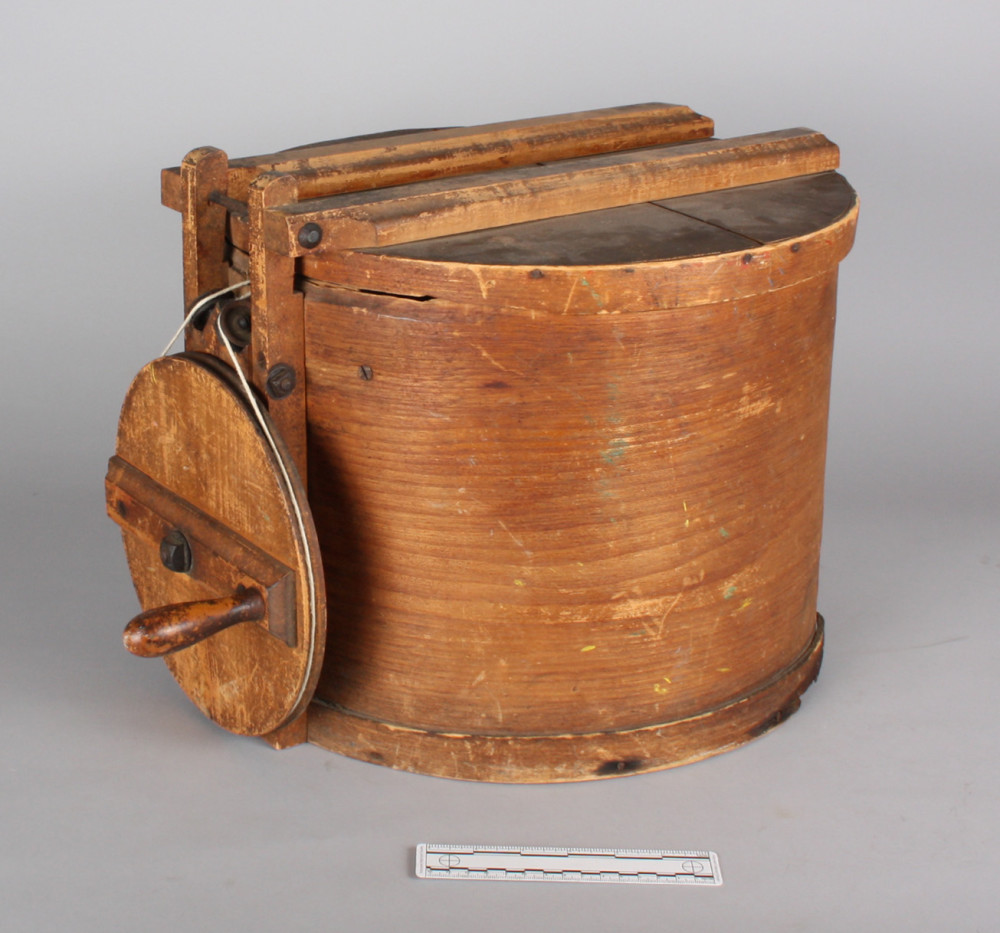
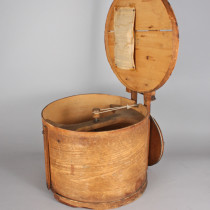
A local manufacturer most likely built this example soon after the test was introduced in 1890 and before cheap metal versions were widely available. It may even have been made by a farmer himself, eager to take advantage of the new technology. Commercial manufacturers, however, soon seized the opportunity Babcock left them. Within just a few years, companies all over the country were producing a wide variety of types and styles of testers, from two-flask designs that clamped on tables to enclosed, cast-iron models spinning 36 flasks by steam power.
Written by David Driscoll, December 2013.
Want to learn more about the Babcock Butterfat Tester?
In this video, Dr. David L. Nelson, Professor Emeritus of the University of Wisconsin-Madison Biochemistry Department explains the science behind the test.
Click on the video title (at left) to open in YouTube.
This object has been featured on WPR's Wisconsin Life!
Produced for Wisconsin Life by Erika Janik
The Babcock butterfat test, developed at the University of Wisconsin, provided a simple and inexpensive way to assess the quality of milk. The test improved standards for milk producers, transforming the nation’s dairy industry and setting Wisconsin on the path to dairy dominance.
Listen below to the segment from Wisconsin Public Radio’s Wisconsin Life.
Erika Janik:
The Babcock butterfat tester transformed the dairy industry and helped Wisconsin become the dairy state. It’s a big story for such a humble object. Wisconsin Historical Museum curator Dave Driscoll shares the story of this transformative invention.
Dave Driscoll:
This is a Babcock tester, but it’s a very unusual Babcock tester, if you look at it from across the room, it looks like a regular old cheese box, and the way it works is the farmer puts the milk with its proper dilution and additives into the flasks, puts the flasks into the tester, closes the lid and cranks the handle on the side, which causes the flask to spin around and the butterfat to collect in the necks of the bottles. There are lots of different kinds of Babcock testers that were produced. Most of them are made out of metal. So this is a pretty unprofessional version, because it could well be homemade. And the reason for that, I think, has to do with Babcock’s approach to the test. In the 1880s, one of the biggest issues facing the dairy industry was how to improve quality, and if you were a creamery, a cheese factory or a butter maker, it was hard for you to tell which farmers were giving you the best milk. So the question is, how to assess the quality of milk? And there were a number of people in Wisconsin working on that.
Frederick Short was an agricultural chemist at the University of Wisconsin Agricultural Experiment Station, and one of the many tasks he performed there was to try and determine an effective butterfat test. So Short came up with the idea that if you use some kind of a chemical solvent in a milk sample that would separate the butterfat from the rest of the milk, and then you centrifuged it to concentrate the butter fat, that would be a more expeditious way to do it. He published this in an article, but left before he got a chance to turn it into a workable test, and that task fell to Stephen Babcock, who got most of the credit and got his name on the final test. This was such a significant test that Babcock and the rest of the faculty at the UW decided that it should be shared with everyone. So Babcock declined to patent it. He felt that this was really created for the benefit of the entire industry, and that everyone would benefit if this was absolutely freely available.
I like this object for two reasons. One is it is so kind of homemade, which I think does connect to that ‘share it with the people’ idea. It’s kind of an embodiment of the Wisconsin Idea in a way. The other thing I like about it is that, in general, the Babcock test story is pretty well-known, but this is a very unusual, odd looking one. This is not your standard Babcock tester, so it kind of tells a different part of the story.
Erika Janik:
That story is part of Wisconsin 101, a collaborative project to explore our history in objects. Wisconsin life is a co-production of Wisconsin Public Radio and Wisconsin Public Television in partnership with the Wisconsin Humanities Council. Additional support comes from Lowell and Mary Peterson of Appleton. Find more Wisconsin life on our website, wisconsinlife.org and on Facebook. I’m Erika Janik.

Wisconsin Historical Society
This object is part of the Wisconsin Historical Society collection in Madison, Wisconsin. Wisconsin History Museum Object #1948.567, A-D.
RELATED STORIES
Becoming the Dairy State
The Men Behind the Butterfat Test
The Babcock Tester and the Wisconsin Idea
How Does a Babcock Tester Work?