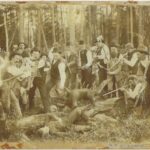
A fearsome sight to behold, the horrible Hodag is rumored to stalk the Northwoods of Wisconsin. First “spotted” in the lumber town of Rhinelander in the late 1800s, the hoax of the Hodag took on a life of its own and made national headlines. Rhinelander’s attempt to separate itself from other failed logging towns during the colonial era was aided by the Hodag folklore that mythicized Rhinelander’s roots of colonization and environmental destruction. Despite the skepticism surrounding its existence, the legend of the Hodag has persisted throughout the years and has become an integral part of local folklore. The Hodag miniature bottle is a representation of Rhinelander embracing the monstrous myth as part of the town’s identity long after its creation.
The House of Spirits in downtown Rhinelander commissioned 600 Hodag decanters (300 male and 300 female) for their liquor store in 1976 to capitalize on the “Hodag craze”. The Hodag’s head somewhat resembles a boar, with two large white horns hugging its ears and long white fangs or tusks. It stands on four legs with clawed feet and spikes running down the length of its spine, and the figure stands on a rock platform. This particular example is of a male hodag, identifiable because the female version does not have tusks. Made of bisque-like porcelain by Milwaukee-based Jon-Sol Bottling Company, the decanter originally contained bourbon. The figure’s head hides a cork stopper while the body and rocky platform served as the bottle. As an iconic symbol of the area, commissioning the bottles was a perfect way to commemorate the myth and promote the region.
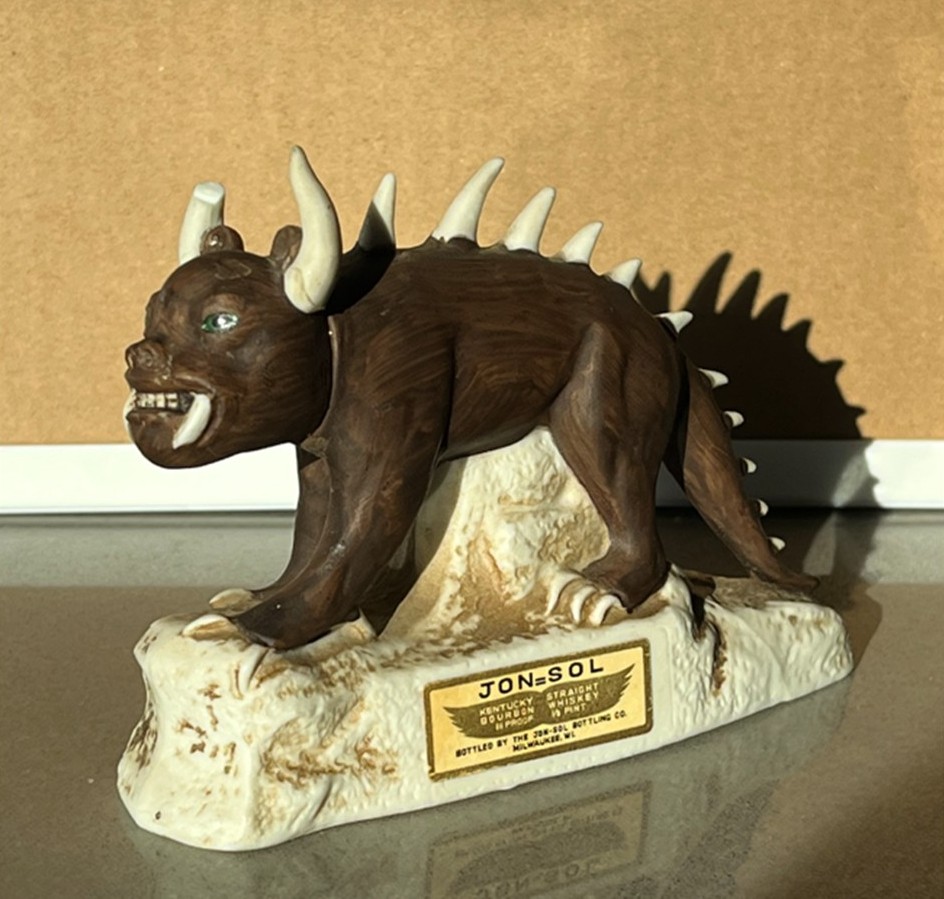
The plaque on the side of the decanter lists the manufacturer, Jon-Sol, and identified the contents as Kentucky Straight Bourbon Whiskey. A label on the underside identifies this as #147 of 600 bottles produced for the House of Spirits in Rhinelander, Wisconsin in the Bicentennial Year 1976. Jon-Sol Bottling Company of Milwaukee specialized in decanters and mini bottles, and produced other decanters shaped as animals specific to Wisconsin collectors, including a red-headed woodpecker, an American robin, a blue jay, and a red-winged blackbird. Though most of their decanters were based on birds, they also produced a totem pole-shaped decanter and a pointer dog.
The Hodag decanter is classified as a miniature bottle due to its diminutive size, about five inches long and four inches high, and because of their small size and inconvenient shapes for transportation, it can be inferred that the Hodag miniature bottles did not penetrate or were not intended for the wider Midwestern alcohol market, but rather specifically for the tourism industry in Rhinelander. The bottle is estimated to hold two shots of Bourbon, so was intended more as a display piece than as a vessel.
Today, the Hodag is embraced by Rhinelander as the official town mascot and remains Rhinelander’s primary tourist attraction. From the myth came the Hodag Music Festival, restaurants and businesses with the name “Hodag” in them, a giant Hodag statue outside of the Rhinelander Area Chamber of Commerce, and other representations of the beast. The Hodag has left an inexpungeable mark on Wisconsin’s cultural landscape and serves as a reminder of our fascination with the unknown, and the icon continues to draw people from around the country to the Northwoods.
Written by Sophie Mullen, May 2023.
Sources
John A. Gutowski, “The Protofestival: Local Guide to American Folk Behavior.” Journal of the Folklore Institute 15, no. 2 (1978): 113–32.
Rhinelander Historical Society, “House of Spirits Hodag Decanter.” https://rhinelanderhistoricalsociety.org/article/house-of-spirits-hodag-decanter/