Not many people would expect that some of the most legendary music of the late twentieth and early twenty first century was made right here in Wisconsin. During its twenty-seven years of operation, Madison’s Smart Studios was a cornerstone of the music scene, responsible for producing a wide array of music all the way from unknown local acts to big-name artists from around the globe.
The story of the “SMART” banner begins with the inception of Smart Studios in 1983. During this time, Butch Vig and Steve Marker, two friends and musicians from the University of Wisconsin–Madison, opened Smart Studios’ first official location in the Gisholt building on East Washington Avenue, right down the hall from Madison-based artist Dennis Nechvatal’s studio. In their first year of operation, Nechvatal created the “SMART” banner for his new neighbors, which hung inside Smart Studios as a decorative backdrop.
The “SMART” banner is hand-painted on a large, white, cotton textile canvas. It features the title “SMART” in bold letters at the top and a collection of disembodied eyes and mouths below, contrasting each other with the former being bright and eye-catching and the latter being dark and crazed.
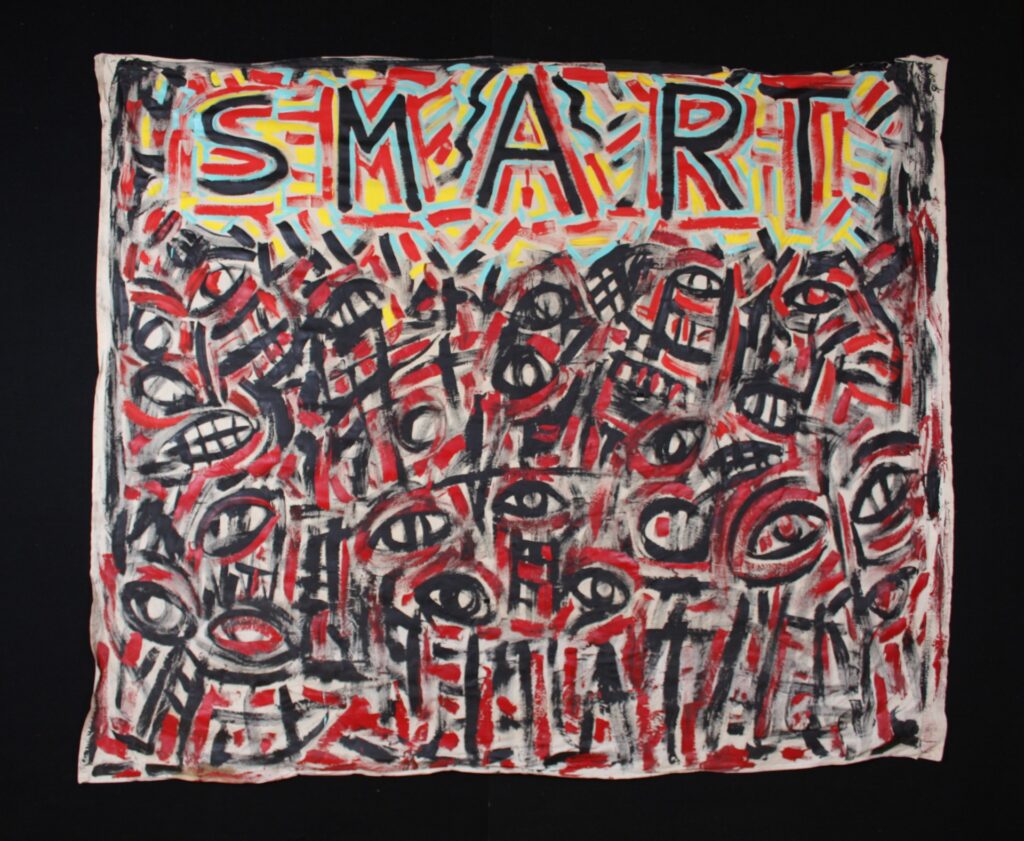
Compared to Nechvatal’s other pieces of art, the “SMART” banner somehow manages to be both similar to and different from his usual style. Nechvatal (who is still active as an artist) often paints detailed images of nature with a heavy emphasis on blues and greens—as opposed to wild splatters of black and red. However, there is still an element of chaos and surrealism in his work that is clearly reflected in the “SMART” banner.
In their early years, the music produced in Smart Studios largely consisted of gritty genres such as punk, rock, and grunge—working with bands such as Killdozer, Tar Babies, Die Kreuzen, and so on. In essence, Smart helped make music that was fast, harsh, loud, and counter-cultural. Nechvatal reflected this frenzied sort of noise in the “SMART” banner’s design, creating an apt representation of the studio in the form of a painted cotton canvas.
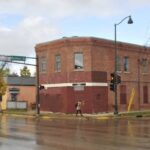
Smart Studios grew as time went on, eventually moving from the Gisholt building in 1987 to their permanent location across the street at 1254 East Washington Avenue. Their success took off after recording with Nirvana in 1990, and they went on to work with more well-known acts over the next two decades, such as The Smashing Pumpkins, Garbage, L7, Fall Out Boy, and Death Cab for Cutie, to name just a few. The studio closed its doors in 2010, and the “SMART” banner was relocated to the Wisconsin Historical Society. It lives on as a piece of Smart Studios, which cemented their legacy in Madison as an unexpected hot spot for great music.
Written by Kaylee Bittner, June 2022
SOURCES
“Artist Biography & Facts: Dennis Nechvatal.” AskArt (website). Accessed March 2022. https://www.askart.com/artist/Dennis_Nechvatal/101627/Dennis_Nechvatal.aspx.
Jim Berkenstadt, “Smart Studios: A History.” Smart Geeks, 2009, http://www.smartgeeks.com/smart.html.
Michael Bonesteel, “Michael Bonesteel on Dennis Nechvatal.” Artforum International Magazine (online), 1 November 1982, https://www.artforum.com/print/reviews/198209/dennis-nechvatal-65602/.
Gary Graff, “Butch Vig on the Making of Nirvana’s Pivotal ‘Nevermind’ and New Doc ‘The Smart Studios Story’: Exclusive Video.” Billboard, 15 March 2016, https://www.billboard.com/music/rock/butch-vig-on-nirvana-nevermind-the-smart-studios-story-exclusive-clip-7262662/.
Wendy Schneider, The Smart Studios Story, Coney Island Studios, 2016, 90 min. https://www.amazon.com/Smart-Studios-Story-Butch-Vig/dp/B01MSD47XU/
Produced for Wisconsin Life by Heewone Lim
In the Wisconsin Historical Society collection, there’s a dark, surreal black and red banner. It’s painted with a chaotic collection of eyes and mouths seemingly calling out to the bold word above them: SMART. This banner served as a backdrop in the legendary Smart Studios in Madison beginning in the early 1980s. It’s a space that recorded iconic Wisconsin bands, like Killdozer and Die Kreuzen, and eventually rock n’ roll legends like Nirvana and Smashing Pumpkins.
Listen below to the segment from Wisconsin Public Radio’s Wisconsin Life.
Maureen McCollum:
In the Wisconsin Historical Society collection, there’s a dark, surreal black and red banner. It’s painted with a chaotic collection of eyes and mouths seemingly calling out to the bold word above them: SMART. This banner served as a backdrop in the legendary Smart Studios in Madison beginning in the early 1980s. It’s a space that recorded iconic Wisconsin bands, like Killdozer and Die Kreuzen, and eventually rock n’ roll legends like Nirvana and Smashing Pumpkins.
Heewone Lim brings us the story of this unique piece of art that once hung in Smart Studios. The “SMART” banner is part of the Wisconsin 101 project, which tells the history of the state through objects.
Heewone Lim:
The story of the “SMART” banner begins with Butch Vig and Steve Marker, two friends and musicians from UW–Madison. The duo opened Smart Studios in 1983 on the east side of Madison. Their recordings hold a legendary space in punk, rock and grunge music history.
Smart Studios first location in the Grisholt building was down the hall from visual artist Dennis Nechvatal’s studio. The first year they were open, Nechvatal created the “SMART” banner for his new neighbors.
Dennis Nechvatal:
We were in communication a lot … just down the halls and drinking beer and misbehaving and stuff like that. So we got to be quite friendly and still are. It just sort of progressively became what it was. I didn’t intentionally put it out there to be a banner or signature statement for their situation, but it all just came into play.
Heewone Lim:
When Vig and Marker moved Smart Studios to its second location on East Washington, the banner came with.
Dennis Nechvatal:
That’s when Smart started to get very serious. That’s when the bigger bands and everybody starts showing up.
Heewone Lim:
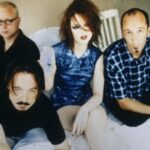
Bands like Smashing Pumpkins, L7, and … Nirvana. Vig and Marker would eventually record their own electronic rock band, Garbage, at Smart Studios.
The “SMART” banner served as a backdrop to these important moments in music history. And, it stands out from Nechvatal’s other artworks, which heavily feature nature, but he still used familiar elements, such as surrealism and facial features.
Dennis Nechvatal:
It’s sort of blending the modern and the primitive together. Modern sort of seems to be out there, but there’s always tomorrow, so it changes. The eyes and the primitive, it’s sort of a motif in all my work.
Heewone Lim:
The banner represents a time in Nechvatal’s life as a young up-and-coming artist. In fact, the materials used to make the banner are unexpected: acrylic paint and secondhand sheets.
Dennis Nechvatal:
I always had an abundance of discarded sheets and they were always cleaned up and so I just stapled that one sheet to the wall and gave it hell.
Heewone Lim:
But what really makes the “SMART” banner unique is the pure, unbridled creativity that went into it.
Dennis Nechvatal:
Give it a shot, you know? Try it. I still do that, but not with the comfort that I used to. Because now, it’s like, I gotta sell a painting.
Heewone Lim:
Nechvatal says that Smart Studios and his own art career took off around the same time.
Dennis Nechvatal:
And so Smart Studios was just part of the growth, ya know? We were all sort of starting together. ‘Cause I was starting to sell paintings in Chicago and other places and bigger cities like that. The whole movement sort of started and just sort of kept going.
Heewone Lim:
But he hasn’t forgotten the humble beginnings of the now historic studios.
Dennis Nechvatal:
It came out of the basement, too, you know what I mean? It can come out of anywhere. It doesn’t have to be out of the big city. A situation like that. Once it germinates, it can be nurtured, and all of a sudden you’ve got something brand new.
Maureen McCollum:
Heewone Lim brought us that story on the Smart Studios Banner, which is part of the Wisconsin Historical Society’s collection. It’s also a part of the Wisconsin 101 project, which tells the history of the state through objects. Wisconsin Life is a co-production of Wisconsin Public Radio and PBS Wisconsin in partnership with the Wisconsin Humanities Council. Additional support comes from Lowell and Mary Peterson of Appleton. I’m Maureen McCollum.
Wisconsin Historical Society
This object is part of the Wisconsin Historical Society collection in Madison, Wisconsin. Wisconsin History Museum Object #1948.567, A-D.