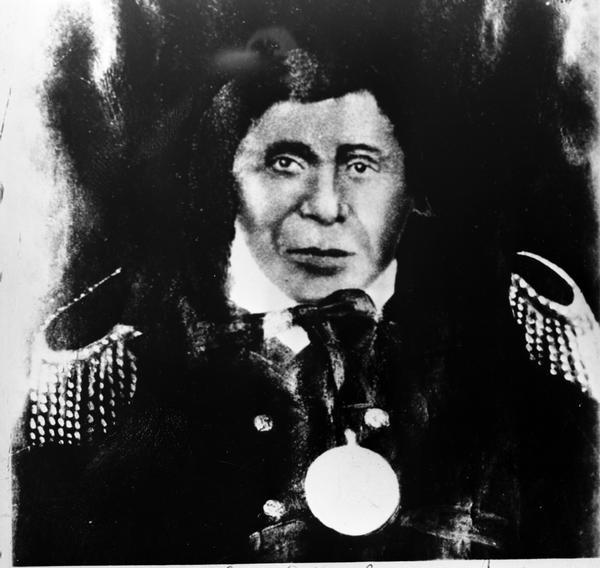
Ke-che-waish-ke (Great Renewer) (c.1759 – 1855), also known as Chief Buffalo (Peezhickee), and by the French Le Boeuf, led the Lake Superior Ojibwe people of Mooningwanekaaning (Madeline Island). Ke-che-waish-ke was instrumental to signing treaty agreements between the Wisconsin Ojibwe people and the United States, beginning with the treaty of 1825 and ending with the treaty of 1854. Known for his work to ensure a conservation of lands for Native Americans in Wisconsin, he resisted aggressive land acquisitions by the United States government. Unlike the physically aggressive means of conflict resolution practiced by neighboring Ojibwe tribe leaders, Ke-che-waish-ke was unique for his use of non-violent negotiations with other tribes and the United States government. Just as his people valued his impressive oratorical skills, other Ojibwe tribes from La Pointe began to recognize his skill and recruited him to serve as their spokesperson in negotiations with the United States.[1]

Ke-che-waish-ke first served as an authority representing a group of Native American Ojibwe tribes in the Lake Superior region for the treaties of 1837 and 1842. The Native peoples highly regarded Ke-che-waish-ke’s input and delayed the proceedings of the treaty of 1837 until he joined them near modern-day Minneapolis several days later.[2] While details about the Treaty of 1842 signing are scarce, Ke-che-waish-ke’s position as a figurehead for these tribes is evident in a letter he wrote several months later. In the letter, he described the treaty and his distaste with the strong-arming of the U.S. Government during the proceedings.[3] The treaties suggest that the United States Government intended to gain control of the La Pointe Band region in Northern and Western Wisconsin to access lumber and metal resources.[4]

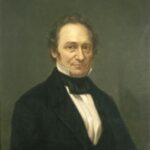
Black-and-white portrait of Chief Buffalo, an over-painted photograph.
Portrait of Chief Buffalo (Peezhickee), also known as Ke-che-waish-ke (Great Renewer); grandson of Great Chief Buffalo, and principal Chief of the Lake Superior Band of Chippewa (Ojibwe). He was born at La Pointe on Madeline Island (Mooningwanekaaning) c. 1759 and died on September 7, 1855. Wisconsin Historical Society Image ID: 3957.
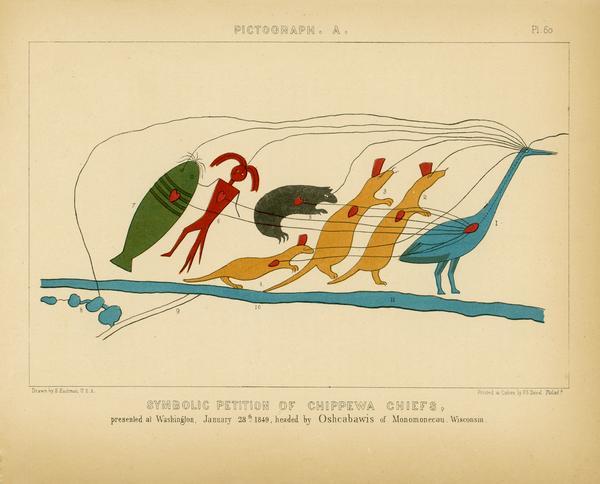
A printed image of a hand-drawn representation of a pictoral petition. It features the representation of seven figures: a crane, three martins, a bear, a man-fish, and a catfish.
A birch bark version of this image was carried by Oshcabawis to Washington in 1849 when the tribe petitioned the U.S. to adjust boundaries of the 1842 LaPointe treaty. It depicted their authority to speak for the Lake Superior bands today called the Lac Courte Oreilles, St. Croix, Fond du Lac, Red Cliff and Bad River Ojibwe. In the decades that followed, it was also used by the Ojibwe to explain the Sandy Lake tragedy of 1850-51. Contemporary elders say that the lines from the hearts and eyes of the Catfish, Man-fish, Bear, and the three Martens to the heart and eye of the Crane signify that all the headmen shared the same views. The last line, going out from the Crane's eye, indicated that the entire group had authorized Chief Buffalo (Crane Clan) to speak to President Fillmore on their behalf. Wisconsin Historical Society Image ID: 1871
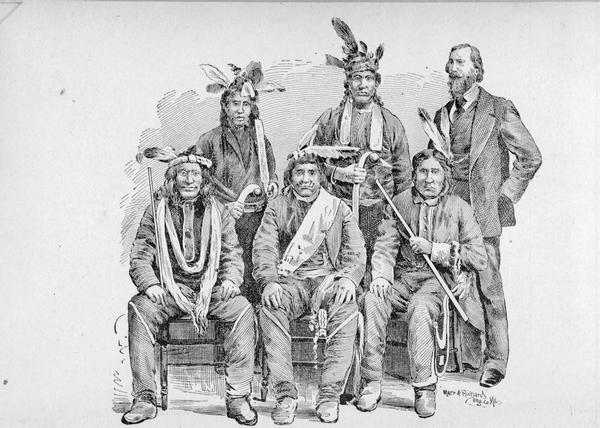
An illustration of a delegation of five Native American men and a white man in beard and suit.
Illustration of the Washington, D.C. Delegation of Indians. From Benjamin Armstrong, "Early Life Among The Indians". According to his book, Armstrong went to D.C. with two chiefs and five braves. The image may include Chief Buffalo and Chief O-Sho-Ga, however there is no caption information with the engraving to identify the men in the image. Wisconsin Historical Society Image ID: 3351

At 93 years of age, Ke-che-waish-ke traveled to Washington D.C. with a group of Wisconsin- and Minnesota-based tribal leaders to discuss ongoing injustices of land and resource control by the U.S. Government with President Millard Filmore.[5] In response, President Filmore rescinded the previous Indian removal order, going against a precedent of Indian relocation from their homelands seen across the United States.

Ke-che-waish-ke’s role as a leader for the Ojibwe people culminated with the La Pointe Treaty of 1854, which solidified his memory in history. In these negotiations, the Native American leaders ceded most of their land on the Wisconsin shores of Lake Superior to the U.S. Government, in return for a guarantee of annual payments, as well as usufructuary rights.[7] These protections allowed for Native peoples to continue using the ceded lands for hunting, fishing, and gathering purposes, regardless of any laws that would restrict United States citizens from doing so.

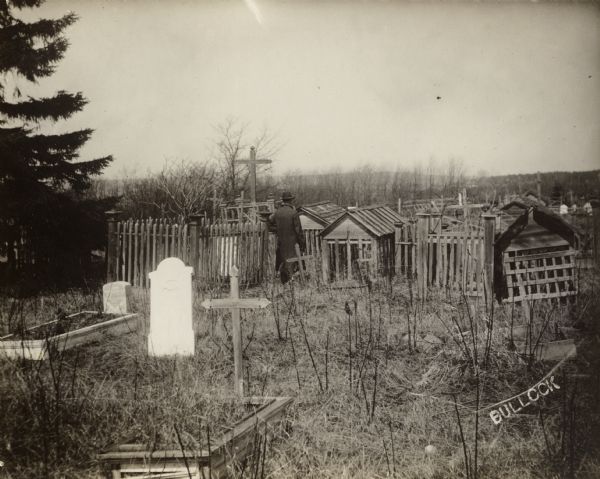
Not long after, Kechewaishke died in 1855 and is buried at La Pointe Indian Cemetery on Madeline Island.

Written by Trase Tracanna, February 2021.

A black-and-white photograph of a Native American burial ground with above-ground tombs.
"Indian Cemetery." Burial grounds at La Point. c. 1918. Wisconsin Historical Society Image ID: 36831.

SOURCES

[1]William W. Warren, in History of the Ojibways, Based upon Traditions and Oral Statements (St. Paul, MN, 1885), p. 48.

[2] Ronald N Satz, “Appendix 1,” in Transactions of the Wisconsin Academy of Sciences, Arts and Letters, ed. Carl N Haywood, 1st ed., vol. 79 (Madison, WI: Wisconsin Academy of Sciences, Arts and Letter, 1991), pp. 131-133.

[3] Ronald N. Satz, in Chippewa Treaty Rights: the Reserved Rights of Wisconsin’s Chippewa Indians in Historical Perspective (Madison, WI: University of Wisconsin Press, 1997), p. 40.

[4] “Ojibwe Treaty Rights,” Milwaukee Public Museum, accessed February 2, 2021, https://www.mpm.edu/content/wirp/ICW-110.

[5]“Miskwaabekong History,” Welcome to Red Cliff Band of Lake Superior Chippewa, accessed February 2, 2021, https://www.redcliff-nsn.gov/community/heritage_and_culture/miskwaabekong_history.php.

[6] “Be Sheekee, or Buffalo,” U.S. Senate: Be sheekee, or Buffalo, January 12, 2017, https://www.senate.gov/artandhistory/art/artifact/Sculpture_21_00002.htm#bio.

[7] Stone, Andrew. “Treaty of La Pointe, 1854.” MNopedia, Minnesota Historical Society. http://www.mnopedia.org/event/treaty-la-pointe-1854 (accessed February 16, 2021).