In the 1890s, mass-produced safety bicycles sparked a bicycle craze across Wisconsin. However, despite the lowered costs associated with mass production, not everyone could afford this new luxury. Walter Atkinson of Ellenboro, Wisconsin, was not going to let a $100 price tag deter him from experiencing the liberating power of bicycle transportation. Tapping into the type of rural ingenuity evident in farmhands from all across southern Wisconsin, Atkinson hand-crafted his own bicycle, the Crab Tree Special, in 1893.
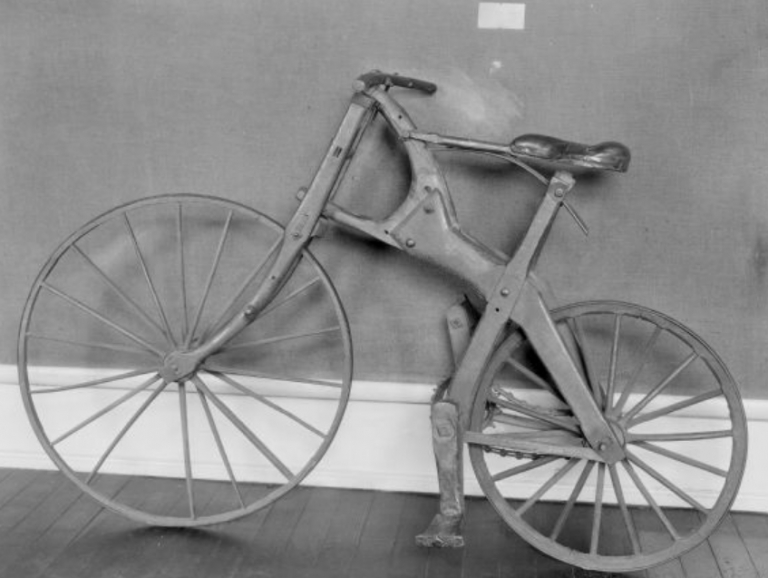
Atkinson, armed with “only a jack knife, an old saw, wood, and other scraps,” created his own version of the popular Sterling safety bicycle. He carved the frame out of a crabapple tree stump and whittled the handlebar, pedals, and other parts out of various maple and white oak scraps. The sprocket, chain, and brace underneath the seat were salvaged from discarded farm equipment and other materials Atkinson had on his farm. As a result, the bicycle has irregularities and odd contours that reflect the “scars of the tools that helped build it.”[1]
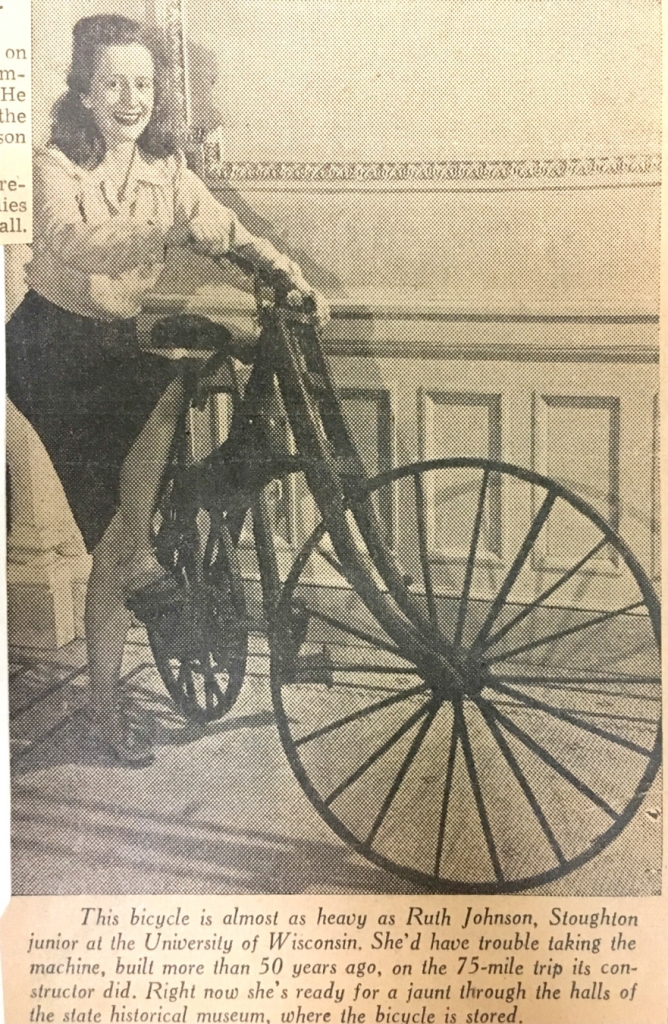
Ruth Johnson, a student at the University of Wisconsin, attempts to ride the Crab Tree Special. Photo taken for an article for the ‘Wisconsin State Journal.’ Image from the Wisconsin Historical Society accession files for the Crab Tree Special, WHS #F1998.91.
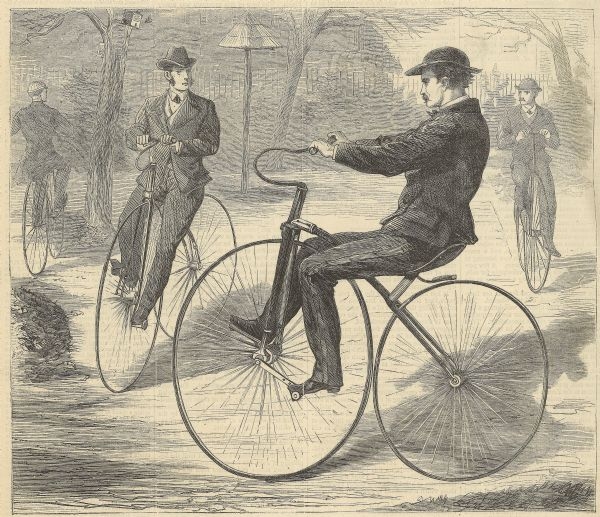
Like the safety bicycle, Atkinson’s Crab Tree Special “allowed for direct steering by using a handlebar placed within easy reach of the rider.”[2] However, while Atkinson’s model had many similarities to the safety bicycles of the time, it was distinctly one-of-a-kind. For instance, Atkinson’s bicycle, with its larger front wheel and slightly smaller wheel at the back, was more similar to the earlier velocipede models in this respect. Additionally, the combination of wood and metal made the Crab Tree Special heavier than most safety bicycles, which by 1895 weighed 20 to 22 pounds.[3]
While the bicycle’s intricate design and the dark finish gives the impression that it was just for show, the worn-down leather seat, chip marks, and the notches in the wooden frame reveal a different story. Atkinson put the Crab Tree Special to good use. He once even rode it 75 miles from Platteville to Madison. Riding the Crab Tree Special was likely labor-intensive considering the weight of the bicycle.
As the expansion of Chicago’s mail order catalogs offered rural communities access to the mass-produced goods of the industrial revolution, rural farm families were offered a “fantasy glimpse of what civilized life was like.”[4] Not always able to afford the goods they saw in the catalogs, many rural families made due with what they had on their farms to create their own version of these new products. The Crab Tree Special is an example of this do-it-yourself spirit.
[3] Henry Clyde, Pleasure-Cycling. (Boston: Little, Brown, and Company, 1895), 46.
[4] William Cronon, Nature’s Metropolis: Chicago and the Great West. (New York, W.W. Norton, 1991), 338.
Though the Crab Tree Special has some features from the Sterling Safety Bicycle, it also echoed the style of velocipedes, shown in this 1886 illustration by Theodore Davis. Image from the Wisconsin Historical Society, #98855.