Immigrants must sometimes reconcile contradictory impulses. Having left their homes to evade oppression or economic hardships, they often seek to recreate familiar communities in their new lands. This synagogue window is a testament to the successful efforts of hundreds of Russian Jews to recreate a familiar community in Sheboygan, Wisconsin in the early twentieth century.
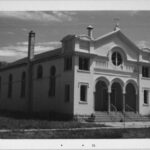
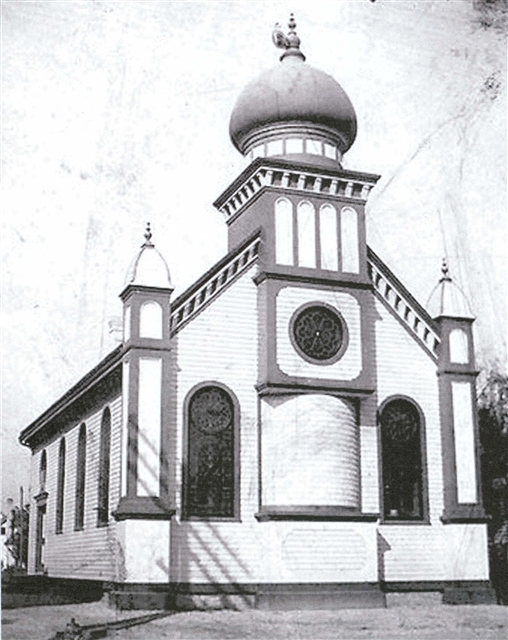
Around 1907 the congregation of Adas Israel (Community of Israel), which had formed in the 1890s, acquired the building that became the city’s second synagogue. In 1910 the congregation moved that building from North 8th Street to the southwest corner of North 13th Street and Carl Avenue, where it became known as “The White Shul.”
The White Shul educated Jewish children and provided spiritual sustenance for Sheboygan’s Jewish community for the next thirty years. But as the founding members aged, many of their children didn’t feel the same connection to the Orthodox Judaism of their parents and grandparents. Membership in Adas Israel declined, and another Jewish congregation grew in its place. In 1944, the children and grandchildren of Sheboygan’s original Jewish immigrants founded Congregation Beth El, a Conservative rather than Orthodox congregation. The Beth El congregation rented the Adas Israel synagogue as its headquarters and Hebrew school from 1945 until its own, newly-built synagogue was completed in September 1951. Congregation Adas Israel formally dissolved in 1953, and their building was sold to a Christian congregation, The Church of God.
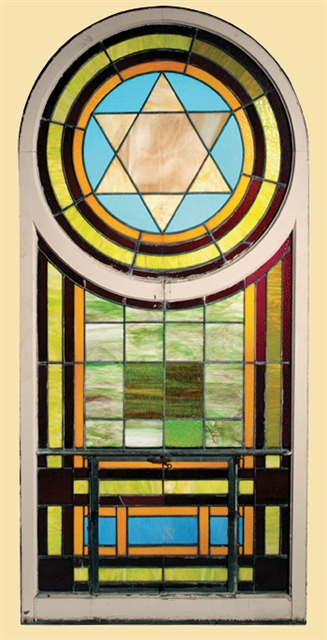
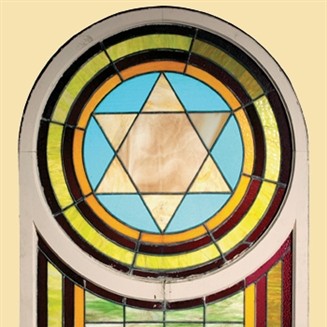
In the following years, the building’s new owners removed most of The White Shul’s original architectural details, including an onion dome. But one window remained, visible only from the rear of the building on a wall facing away from the street. This leaded window features a Magen David (Star of David) pattern of colored glass set into a wooden frame. The window’s maker is not known, but it likely dates from about 1910, when the building was moved to its final location.
After World War II, Congregation Beth El became the center of Jewish life in Sheboygan. As late as 1960, there were about 250 Jewish families living in Sheboygan, with perhaps 1,000 members. In recent decades, however, that number has declined significantly. Joel Alpert explained the decrease at a 1999 reunion of the Jewish Community in Sheboygan: “as the second and third generations became educated beyond the local job market, they emigrated to larger cities.”
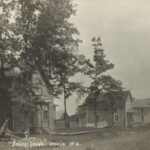
One of these educated émigrés is Sheboygan native David Schoenkin, who now lives in New York. David can trace his Sheboygan roots to his grandfather, Charles Schoenkin, who left the “Pale of Settlement”, a territory where the Imperial Russian state confined its Jewish subjects, and settled his family near the White Shul in the early 1900s.
On his periodic visits back to Sheboygan, David Schoenkin would pass the former Adas Israel building and notice the surviving Star of David window. In 2006, he felt compelled to preserve this reminder of Sheboygan’s Jewish history. He traded a new, energy-efficient window to the current occupant of the building, in exchange for this evocative artifact. Along with his brother Charles and his sisters Kathy and Marsha, David donated the Star of David window to the Wisconsin Historical Society in memory of their parents, Nathan and Susan Schoenkin.
History does not stand still. The faith of Sheboygan’s first Jewish immigrants evolved in its new American surroundings, and many of their descendants have dispersed throughout the country. The White Shul is no longer a synagogue. Still, this window survives as a tangible reminder of how, as David Schoenkin told The Sheboygan Press in 2006, “Wisconsin opened its arms to those that wanted to build new lives and have the freedom to practice their religion.”
This story was edited and adapted from David Driscoll’s original Curators’ Favorites article (September 2007).
SOURCES
Adas Israel Congregation, Minutes and Financial Records, ca. 1900-1931, WHS Library Microfilm 342 (P83-1345).
Congregation Beth El, Sheboygan,”25th anniversary, Congregation Beth El, 1944-1969″ Commemorative booklet. Sheboygan, WI: The Congregation, 1969.
“Former Synagogue Will Have Star of David Preserved,” The Sheboygan Press, 9 June 2006.
“JewishGen”, a Jewish genealogical web site, hosts a very informative collection of stories, recollections and photographs of Sheboygan’s Jewish community at www.shtetlinks.jewishgen.org/Sheboygan/.
A guide to the history and culture of Jewish Belarus, at www.belarusguide.com/culture1/.
This object has been featured on WPR's Wisconsin Life!
Produced for Wisconsin Life by Molly Hunken and Maureen McCollum.
In the early 20th century, millions of Jewish people fled Russia due to persecution and poor quality of life. Some of them ended up in Wisconsin. In Sheboygan, a former synagogue with an historic stained glass window acts as a testament to the area’s once thriving Jewish community.
Listen below to the segment from Wisconsin Public Radio’s Wisconsin Life.
Maureen McCollum: In the early 20th century, millions of Jewish people fled Russia due to persecution and poor quality of life. Some of them ended up in Wisconsin. In Sheboygan, a former synagogue with an historic stained glass window acts as a testament to the area’s once thriving Jewish community. Molly Hunken brings us their story.
Molly Hunken: Most Jewish people who immigrated from Eastern Europe to the United States came to cities, but some did settle in smaller towns. One such community was Sheboygan, Wisconsin.
With a population nearing just 23,000 by 1900, the town of Sheboygan was small, not somewhere you might imagine large groups of new U.S. immigrants flocking to. However, according to Susie Alpert Drazen, was where employers were hiring. Her first family member arrived there in 1904.
Susie Alpert Drazen: They said, “Well,” and pointing to a map of the United States, “You can find work here, here, and here. And they’re hiring here, here, and here.” So they fronted him train ticket money, and away he went to Sheboygan, Wisconsin.”
Molly Hunken: The first synagogue in Sheboygan opened its doors in 1903. And by the time Drazen was growing up there, Sheboygan was home to three synagogues.
Susie Alpert Drazen: The synagogue that my family belonged to, it was called The Brick Shul — shul being a Yiddish word for synagogue. That was because it was made of bricks. There was also a White Shul, because it was white. And then there was the Holman Shul, which the Holman family founded.
Molly Hunken: The White Shul had originally formed in the 1890s as an Orthodox congregation called Adas Israel, meaning “Community of Israel.” The architecture of The White Shul included a large onion dome at the top of the building as well as a stunning stained glass window that featured a Star of David.
David Driscoll: The window is about six-and-a-half feet high and three feet wide.
Molly Hunken: That’s David Driscoll, a curator at the Wisconsin Historical Society. He showed me the window, which is now hanging up in their storage facility.
David Driscoll: And in the middle there’s a leaded glass Star of David, that’s kind of a mottled white and brown color.
Molly Hunken: The Wisconsin Historical Society has been able to preserve this key remnant of Adas Israel. And according to Susie Drazen, the window’s material has an important purpose in Jewish culture and religion.
Susie Alpert Drazen: In Judaism, there is a concept called ‘Hiddur Mitzvah,’ and it means that we are beautifying the mitzvah. It’s like dressing up to go to church or to synagogue. A stained-glass window is something special. A stained-glass window is something extra. It’s beautiful.
Molly Hunken: Jewish families attended services, educated their children and became involved in the vibrant community surrounding The White Shul for decades. But, by the 1940s, much of the new generation of Sheboygan’s Jews didn’t feel as connected to Orthodox Judaism. So in 1944, the Orthodox congregations of Sheboygan were largely replaced by a new group, called Congregation Beth El, which is the only remaining synagogue in Sheboygan, and over the past few decades, Sheboygan’s Jewish population has shrunk considerably.
Jonathan Pollack is the chair of the History Department at Madison Area Technical College, and an honorary fellow of the Center for Jewish Studies at UW-Madison. He says this is a common trend.
Jonathan Pollack: Jewish families in small towns, especially, ya know, starting really in the 1920s, saw college as a great thing and something they wanted their kids to pursue for all the opportunities that a college education brought. That same education meant that a lot of people were not going back home.
Molly Hunken: Having grown up in Sheboygan, Drazen agrees.
Susie Alpert Drazen: We were not encouraged to stay. We were encouraged to go to college, make a life, and perhaps find a larger Jewish community to be part of.
Molly Hunken: Drazen and Pollack both think that unless more job opportunities arise in Sheboygan, the Jewish community will likely continue to shrink. However, pieces like the Star of David window are an important reminder of the rich history of Jewish culture in Sheboygan.
Maureen McCollum: Molly Hunken brought us that story on a Sheboygan synagogue. The building’s stained-glass window is part of the Wisconsin 101 project which tells our state’s history through objects. Wisconsin Life is a co-production of Wisconsin Public Radio and PBS-Wisconsin in partnership with Wisconsin Humanities. Additional support comes from Lowell and Mary Peterson of Appleton. I’m Maureen McCollum.

Wisconsin Historical Society
This object is part of the Wisconsin Historical Society collection in Madison, Wisconsin. Wisconsin History Museum Object #2006.108.1.1. It has also been featured as part of the Curators’ Favorite Collection. Explore more objects from the collection here!