Erika Janik:
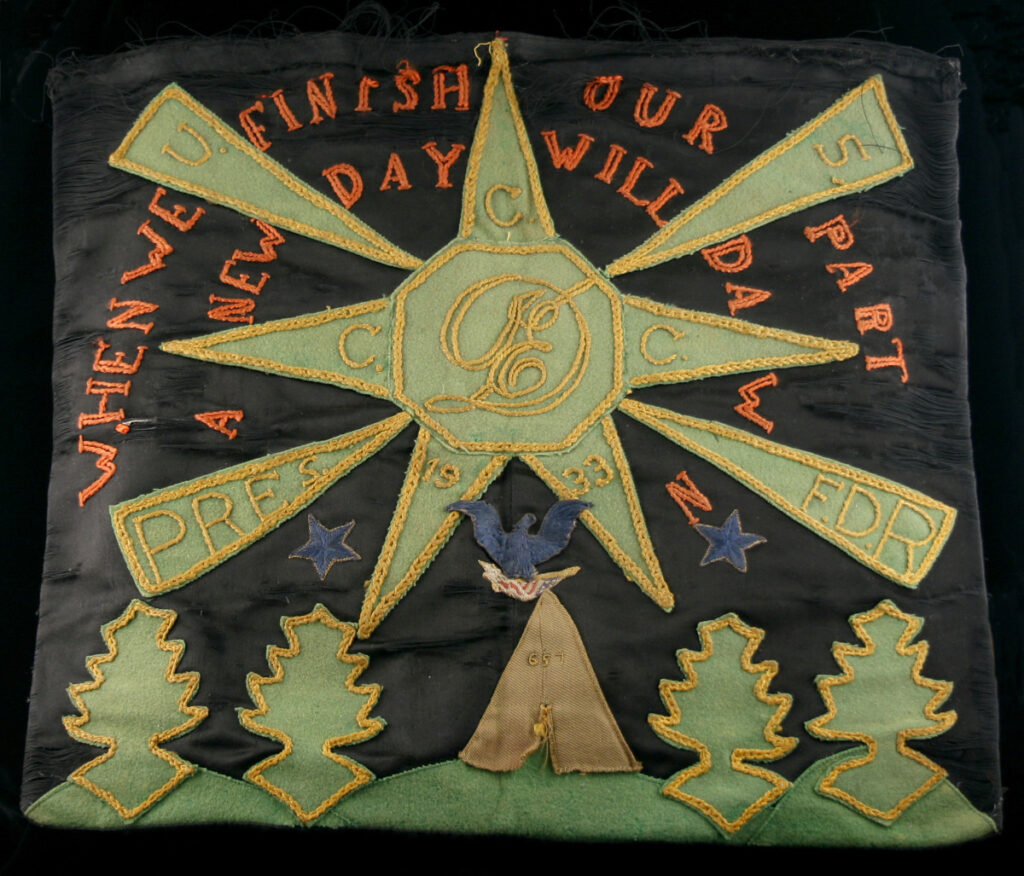
Rose Mary Drab created a pillow sham to honor her brother’s service in the Civilian Conservation Corps. As part of our ongoing look at Wisconsin through objects, Joe Hermelin shares the stories woven into this 1930s textile from Langlade County.
Joe Hermolin:
I knew about the CCC Civilian Conservation Corps in general. And when I moved to Antigo about 12 or 13 years ago, I started getting interested in the history of the area. And then when Ed drab came into the museum about eight or nine years ago to talk about his experience in the CCC and the pillow Sham, a very tangible item related to the CCCs. It piqued my interest.
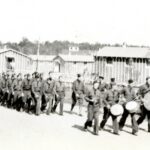
Ed Drab, first of all, he was the son of Hungarian immigrants who had first come to Chicago, and then they moved up to Northern Wisconsin and got a farm during the Depression. They were in hard times, and he went off to the CCC camp. The farm was a little bit south and east of Antigo, and the camp was north of Antigo, so he wasn’t that far from home. It was made by woman Rose Mary Drab to honor her brother, Ed, who was heading off to the CCCs. It’s applique. She appliqued a black cotton sateen Sham. It’s about the size that would cover a pillow. There’s a small cotton tent on it, an eagle. There are two small stars, some scenes of hills and pine trees. And there’s a large sunburst, all in green felted wool. The text, the embroidery, says, CCC, US Pres, FDR, 1933, and camp 657, which was the name of the camp he was stationed at. And that slogan, “When we finish our part, a new day will dawn,” all in red thread. And I thought, here is an impoverished farm family in the depression and the optimism that’s expressed in that that pillow Sham, the embroidery text, and that’s a main reason why I was attracted to it.
Rose Mary Drab. She did do other embroideries and tapestry. She made a commemorative tapestry commemorating the CCCs, and it hung in the White House. She donated it to FDR. It was later transferred to the Roosevelt Museum in Hyde Park. She was quite active in embroidery. She started all this at about, I think she was about 10 years old when the mother of family died, and she, she was 10 and became the house caregiver and taking care of things for the family. Well, different camps had different roles. The style of the camps were such that you signed up for six month term, but it was renewable for up to two years, and he was fairly fresh out of high school, no job prospects. He was paid $30 a month, 25 of which was sent home, so he had $5 a month for himself, and he credits that $25 a month and $25 a month that his younger brother eventually sent back home when he enrolled saving the family farm. They needed that money during the Depression.
Erika Janik:
That story was part of Wisconsin 101, a collaborative project to explore Wisconsin’s story through objects. Wisconsin Life is a co-production of Wisconsin Public Radio and Wisconsin Public Television, in partnership with the Wisconsin Humanities Council. Additional support comes from Lowell and Mary Peterson of Appleton. Find more Wisconsin Life on our website, wisconsinlife.org and on Facebook. I’m Erika Janik.