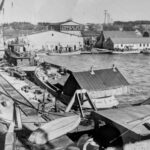
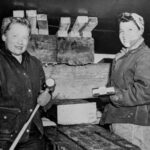
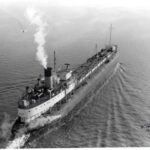
At only sixteen years old, Mercedes Herman stepped forward as one of the first Wisconsin women to join the local manufacturing workforce in Door County during the second World War, operating as a shipyard welder at Sturgeon Bay Shipbuilding and Drydock Company. This company played a particularly significant role in the production of steel maritime vessels, launching a total of eighty-five ships throughout the war years. Mercedes Herman began her employment in 1943, when it began manufacturing fifteen-hundred-foot cargo ships for the Quartermaster Corps, 176-foot supply vessels for the Transportation Corps, and 45-foot motor tenders. The work of welders like her — along with many female electricians, factory workers, stock clerks, operatives, and shipfitters — is what held these massive metal ships together. Her unique welding uniform carries the story of her own work, while concurrently reflecting the broader movement for women’s industrial employment that arose from the wartime demands of the early 1940s.
Above all else a practical garment, the material design of standard welding uniforms shielded their wearers from direct contact with dangerous conditions in daily working life. Acting as full-coverage attire made entirely of leather — a decent electrical insulator and retardant shield against sparks — the uniform would have actively protected its wearer from exposure to the flame-related hazards of welding jobs, like Mercedes Herman’s at Sturgeon Bay Shipbuilding and Drydock Company. The front of the jacket closes neatly over ordinary flammable clothes with seven metal snaps, while an additional snap button secures each roll-up cuff. Gold buckles connect to the shoulder straps and the waistband of the overalls, while silver fasteners clasp on the fly and along the side of the waist, ensuring that the garment remains in place through any range of motion. Large back pockets on the overalls also acted as a practical place to hold one’s tools.
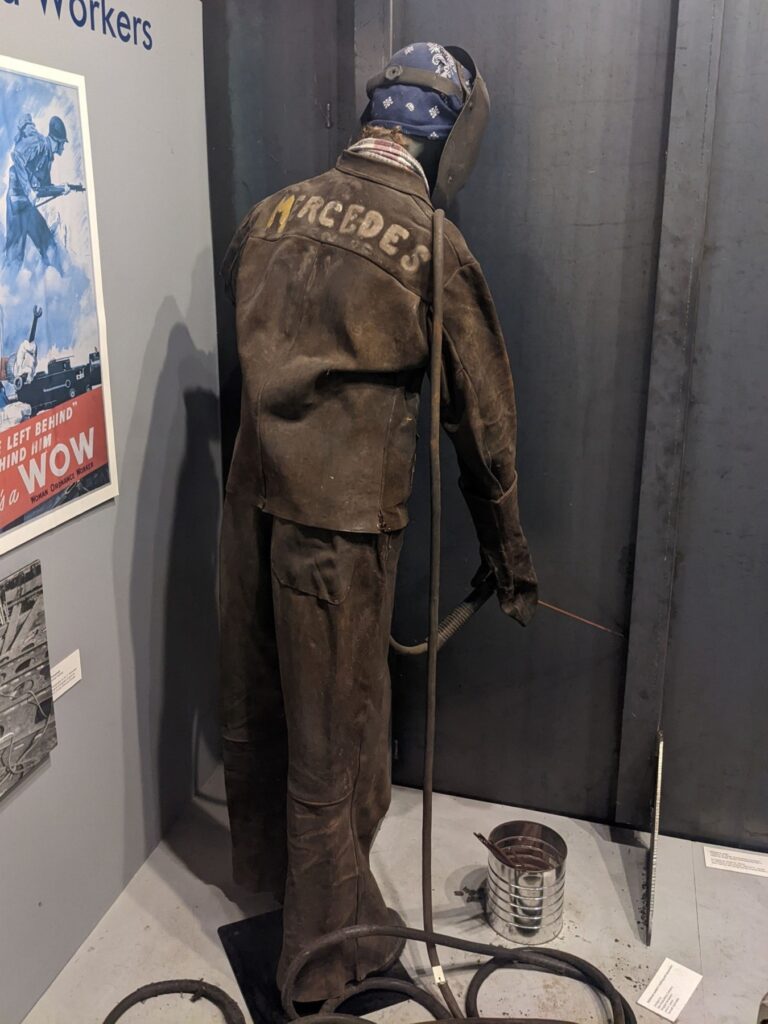
The unique details and worn-in quality of Mercedes Herman’s personal uniform speaks further to the significance of her role as a shipyard welder. As demonstrated by the yellow paint that decorates the front pockets of her jacket and spells “Mercedes” across the back shoulder panel, employees identified themselves as unique individuals and expressed pride in their strenuous work. For Mercedes Herman, this detail relays the specific empowerment of her situation as she joined the mothers, wives, sisters, and daughters who rallied to fill the gaps in male-dominated industrial work left by those who enlisted during the second World War, rising to meet the wartime manufacturing demands of the government. Her leather uniform possesses visible abrasion and uneven coloring across all external surfaces, reflecting many hours of productive use from her two years of employment at the shipyard and speaking directly to the perseverance and diligence of its owner.
Ultimately, Mercedes Herman’s welding uniform saw retirement when she concluded her employment at Sturgeon Bay Shipbuilding and Drydock Company in 1945 — the same year World War II ended. Though the war enabled great productivity in the industrial businesses of Door County and its local community, this enthusiastic boom could not last forever, and many workers headed home to their families after its closure.
Written by Serena LaLuzerne, June 2025.
Sources
“Mercedes B. ‘Merc’ Zak.” Green Bay Press Gazette, September 5, 2019. https://www.greenbaypressgazette.com/obituaries/wis257633.
Herb Reynolds, “Sturgeon Bay Shipbuilding and Dry Dock Company.” Sturgeon Bay, WI: Door County Maritime Museum, 2023.
Door County Maritime Museum
Research for this object and its related stories was supported by the Door County Maritime Museum in Sturgeon Bay, Wisconsin.