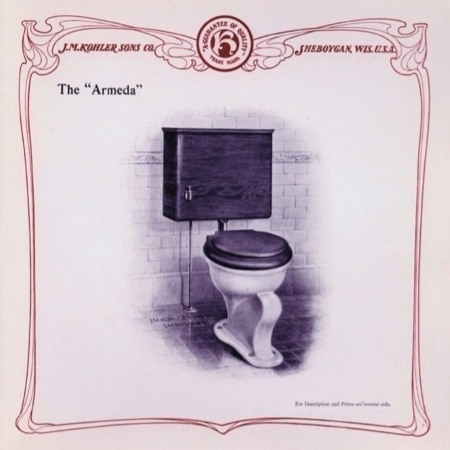
OBJECT HISTORY: The 1904 Kohler “Armeda” Toilet
By the year 1904, when the “Armeda” toilet pictured here appeared in the Kohler Company’s product catalogue, Sheboygan-based Kohler had become one of the largest makers of bathroom furnishings in the United States. Even at this early date in its history, as this catalogue illustration shows, the company sought to position itself at the luxury end of the booming market in the construction of new homes.

The Early History of the Kohler Company
After the sale of the foundry, Jacob began a new business that hoped to specialize in the production of enamelware, such as tea kettles and cooking pots, for use in kitchens. In search of better results, Jacob dispatched his son Andrew to Germany, to learn how to improve the process. Andrew’s trip was basically a form of industrial espionage, and it was made possible by his knowledge of foundry work and his fluency in German. He returned to Sheboygan in 1874 with the essential techniques in hand.
The Bathroom as a Household Space
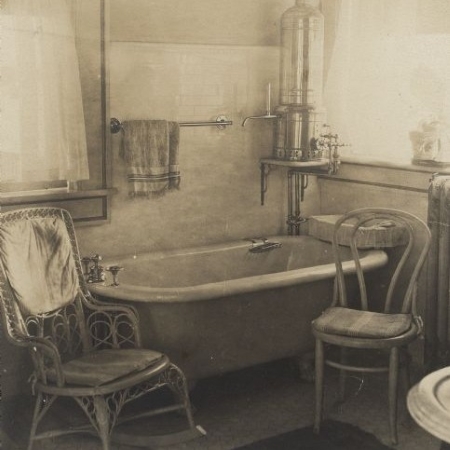
When we think of a “bathroom,” we usually imagine a room containing three standard fixtures—a bathtub, a sink, and a toilet. Bathrooms such as these are so universal in homes today that we can hardly imagine a time when they did not exist. But in fact, bathrooms as we know them are comparatively recent in origin and began appearing in American middle-class homes in large numbers only during the last third of the 1800s.