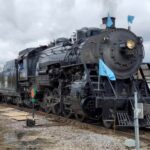
In the second half of the nineteenth century, railroads remade the geography of the Midwest. In an era when roads were often muddy filled with holes, the railroad made it faster to travel from Superior to Milwaukee by rail than from Superior to Ashland by wagon. In Wisconsin, the Chicago and Northwestern, The Milwaukee Road, and the Soo Line were the major railroads. They crossed the state and connected the produce of farmers and miners and lumberyards to port cities on the Great Lakes, the barges on the Mississippi, and most importantly, to the commercial markets in Chicago. The Soo Line Engine #1003 represents that history.
The Soo Line
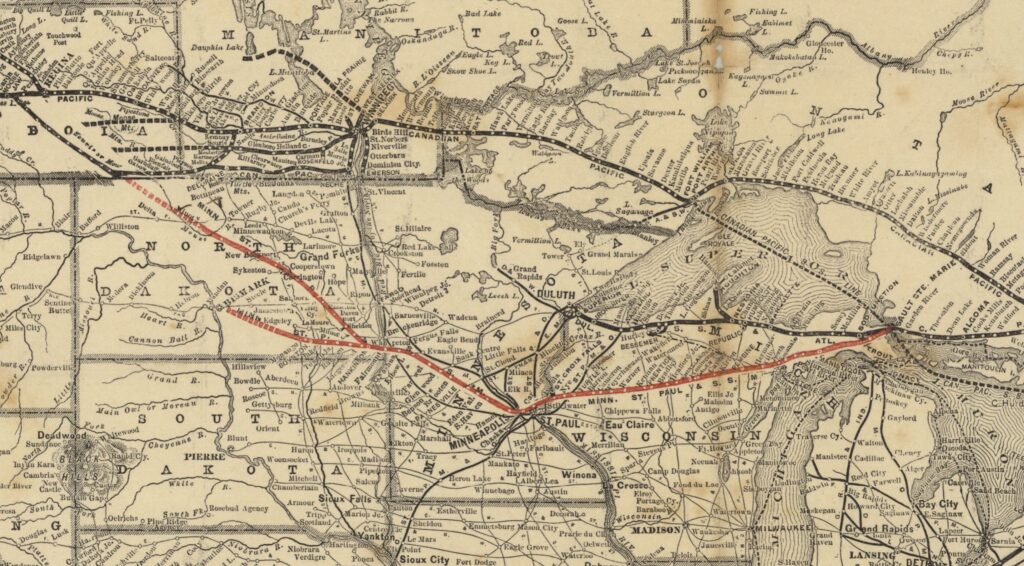
One of the major routes that served Wisconsin during the steam era pulling freight and passenger trains was the Minneapolis, St. Paul, and Sault Ste. Marie Railroad; known as the Soo Line, for its endpoint in Sault St. Marie (pronounced “Soo Saint Marie”). Stretching from North Dakota to the Upper Peninsula of Michigan, the Soo Line has a large amount of track connecting cities and ports across northern Wisconsin.
The Soo Line began in 1883 when a group of mill owners in Minneapolis decided to fund and build a direct line between their city and their major shipping port at Sault Ste. Marie. Before the Soo Line, if you were a grain merchant in the Upper Midwest or Great Plains, your only real options were to send your grain to eastern markets through shipping companies owned by the railroad monopolies operating out of Chicago, or by railroad and steamship lines controlled by James J. Hill based in Duluth-Superior.
Detail from the c. 1890 'Map of the Minneapolis, St. Paul & Sault Ste. Marie Railway (Soo Line) and the Canadian Pacific Railway and their connections.' The red line shows the route of the MStP&SMM Railway (The Soo Line).
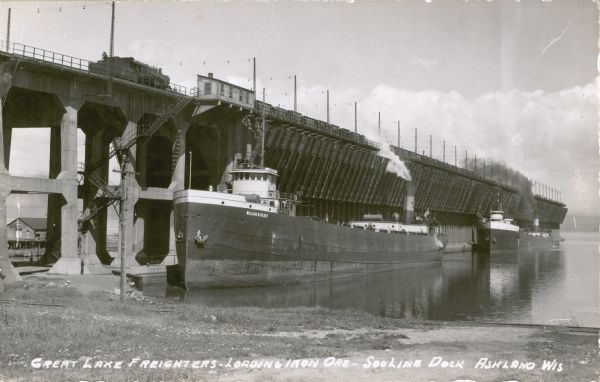
A Soo Line train loading iron ore onto Great Lakes freighters at the ore docks in Ashland, Wisconsin, ca. 1935.
Photo by Franklin Merritt via the Wisconsin Historical Society, #131297.
These Minneapolis mill owners formed a railroad company called the Minneapolis, Sault Ste. Marie & Atlantic Railway (MSSM&A) to allow their grain companies to avoid sending shipments through Chicago. Construction began in the spring of 1884 on a 60-mile stretch near Turtle Lake, Wisconsin, and the first train departed from Minneapolis on a ceremonial tour celebrating their progress in November of that same year—reaching its final destination 46 miles away at Bruce, Wisconsin. Workers completed the full route from Minneapolis to Sault Ste. Marie in 1887.
The Soo Line was primarily a freight railroad, meaning that it never was a major passenger rail, because its route was much longer than competing railroads (and because it did not have direct access to Milwaukee). Its first freight train departed in January 1888 with 102 cars of flour, divided into five sections corresponding to their ultimate arrival points: New York City, Boston, Philadelphia, London, and Glasgow. By this time, the Soo Line traced a path through the Northwoods (Wisconsin and Michigan’s Upper Peninsula), carrying both grain from Minnesota and the Dakotas and lumber products from Wisconsin and Michigan to docks at Sault Ste. Marie.
The growth of the Soo Line, as was common of so many American railroads, was a process of mergers and consolidations of railroad companies. Before the route from Minneapolis to Sault Ste. Marie was completed, the MSSM&A merged with the Minneapolis & Pacific Railroad to connect wheat farmers in the Dakotas to flour mills in Minnesota to shipping ports on the Great Lakes. These two companies (as well as a few smaller companies) came together to form the Minneapolis, St. Paul & Sault Ste. Marie Railway (MStP&SSM). The name a mouthful, this was shortened to the Soo Line. In 1908, the Soo Line acquired the Wisconsin Central Railway, in 1910 it acquired the Cuyuna Iron Range Railway, and in 1921 It acquired the Wisconsin and Northern Railroad. All of these mergers meant that by the 1920s, the Soo Line was the major railroad throughout the Northwoods, linking lumber companies, iron mines, and flour mills with ship yards in Superior, Ashland, and elsewhere on the Great Lakes.
Written by Ben Sipiorski, April 2019. Edited and expanded August 2025.
SOURCES
Patrick C. Dorin, The Soo Line. Burbank, Cal.: Superior Publishing Company, 1979.
Soo Line Railroad Company records, 1855-1994. Minnesota Historical Society. https://mnpals-mhs.primo.exlibrisgroup.com/permalink/01MNPALS_MHS/ge68j0/alma990017145410104294
Wisconsin Automotive Museum
This object is part of the Wisconsin Automotive Museum Collection in Hartford, Wisconsin. Research for this object essay and its educational materials was supported by the museum.