Christopher Latham Sholes worked with his brothers at a Green Bay newspaper after having completed a printing internship in 1837, and in 1840 he moved to Kenosha to serve as the owner and publisher of the Southport Telegraph for a number of years.
His involvement in politics first began with the Free Soil Party, which organized in 1848, the same year that Wisconsin became a state. The party’s main platform was that all new U.S. territories be non-slave states. Most Free Soilers eventually joined the Republican Party. That year, Sholes also began serving in the state senate. Several terms later, he joined the assembly where he was instrumental in abolishing the state’s death penalty in 1853 under Governor Leonard J. Farwell.
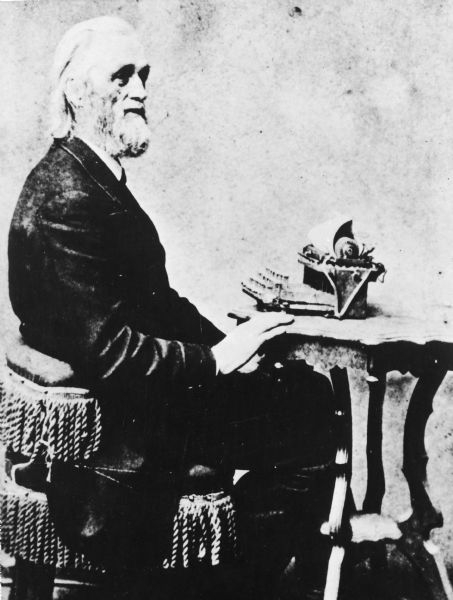
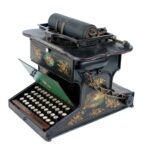
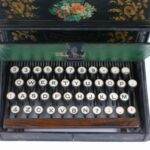
Sholes managed Madison’s Enquirer paper for a time; and in 1860 he became editor of both the Milwaukee News and the Milwaukee Sentinel, a position that he gave up during the Civil War when President Lincoln appointed him as collector of the Port of Milwaukee. In this role, he inspected and collected port fees and import duties. Sholes was chief operator for the Western Union Telegraph Company and an anecdotal story passed on says that one day Sholes needed to borrow carbon paper from someone because he wanted to display his current invention. His invention was, of course, the typewriter, which he spent the better part of his life perfecting.
Near the end of his life in 1900 Sholes said that his invention had done a great deal for women in allowing them to find employment outside the home.
Christopher Latham Sholes posing at a typewriter. Image from the Wisconsin Historical Society, #3218.
SOURCES
Tim Hartford, “How did the qwerty keyboard become so popular?” BBC World Service, 23 April 2019. https://www.bbc.com/news/business-47460499
George Carl Mares, The History of the Typewriter. London: G. Pittman, 1909.
Darryl Rehr, “The First Typewriter,” Type Tisdale. http://typetisdale-typetisdale.blogspot.com/2012/02/first-typewriter-darryl-rehr.html
Charles Smith, The Expert Typist. New York: The Macmillan Company, 1922.
Jimmy Stamp, “The QWERTY Keyboard Will Never Die. Where Did the 150-Year-Old Design Come From?” Smithsonian Magazine. 3 May 2013. https://www.smithsonianmag.com/history/the-qwerty-keyboard-will-never-die-where-did-the-150-year-old-design-come-from-49863249/
Charles Edward Weller, “The Early History of the Typewriter,” Today in Science History. https://todayinsci.com/S/Sholes_Christopher/SholesChristopher-HistoryOfTheTypewriter.htm