Was QWERTY designed to slow down the typist, or was it a deliberate design for telegraphers?
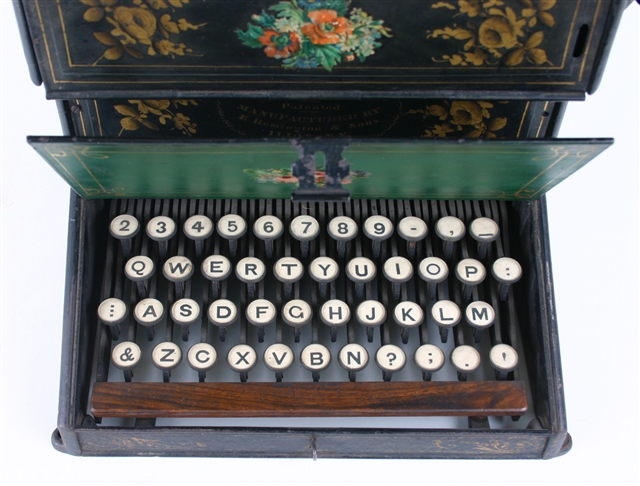
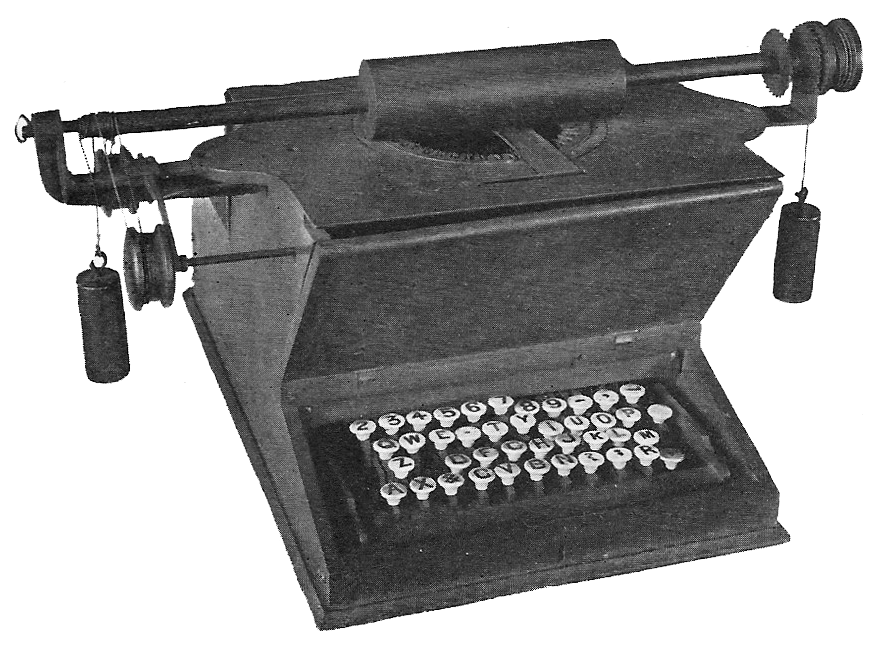
Christopher Latham Sholes‘s early typewriter models contained a keyboard that resembled a piano with an alphabetic arrangement of keys, with two rows which contained the letters of the alphabet, numeric digits, and two articles of punctuation–the period and the dash. Sholes, though, continued to work to perfect his invention. In 1868, he reversed the order of the second half of the alphabet, so the keys read A-M and Z-N. By 1870, the keyboard layout had evolved from two rows to four: numbers appearing on the top row, vowels and punctuation on the second (now with comma and question mark), and then two rows of consonants (B-M and Z-N). In 1873, when Sholes and his backer pitched the invention to Remington & Sons, their prototype included a prototype with a QWERTY-type keyboard.
One of the most popular theories about the development of the QWERTY keyboard is that Sholes had to redesign his initial keyboard because of mechanical failings–when typists typed too quickly, the type bars would tangle and the machinery would jam. This explains why the most commonly used letters are pushed to the edges of the keyboard, and why letter arrangements common in the English language (like ‘TH’, ‘SH’, and ‘ND’) are broken up.
Sholes & Glidden Type Writer, 1874. The familiar “QWERTY” keyboard layout, virtually unchanged to this day, was featured on the very first Sholes & Glidden machines. There is no “shift” key because the machine only typed capital letters. Wisconsin Historical Museum, Object #1964.31.
A circa-1873 prototype of the Sholes & Glidden Type Writer shows the development of the QWERTY keyboard. Image via Wikimedia Commons.
However, this theory cannot explain why the ‘E’ and ‘R’ keys are right next to each other, even though ‘ER’ is the fourth most common letter pairing in English. (One of Sholes’s early prototypes addressed this problem by swapping the ‘R’ key and the comma key–though this version doesn’t seem to ever have been produced commercially).
The first typewriter produced by Remington, the Remington 1 (also known as the Sholes & Glidden Type Writer), did not have the QWERTY keyboard, but an alphabetical one. So while it is commonly thought that Sholes designed his typewriter keyboard to keep the machine from jamming, this may not be the real reason for the layout.
The first typewriter that Sholes sold (before Remington) was in 1868 to Porter’s Telegraph College in Chicago. Others point to this fact to argue that the QWERTY layout was actually designed specifically for the convenience of telegraph operators transcribing Morse code, and those of this belief point to the fact that the ‘Z’ key is next to the ‘S’ and ‘E’ keys, because ‘Z’ and ‘SE’ are indistinguishable in Morse Code–so a telegraph receiver would hover over those three letters until context made clear what keys to strike.
Perhaps both theories are partially true. The QWERTY keyboard was patented in 1878 and appeared on all subsequent models of Remington Typewriters (from the Remington 2, on). In a somewhat sinister theory, some have argued that Remington adopted the QWERTY keyboard precisely because it was not intuitive. This not only allowed them to provide training courses (at a small fee) to teach typists their keyboard, but also ensured that those trained on a QWERTY keyboard would insist upon having a Remington at their desk.
Regardless of the reason, several of the country’s largest typewriter manufacturers merged to form the Union Typewriter Company in 1893, which adopted the QWERTY keyboard as the universal standard.
Tim Hartford, “How did the qwerty keyboard become so popular?” BBC World Service, 23 April 2019. https://www.bbc.com/news/business-47460499
George Carl Mares, The History of the Typewriter. London: G. Pittman, 1909.
Darryl Rehr, “The First Typewriter,” Type Tisdale. http://typetisdale-typetisdale.blogspot.com/2012/02/first-typewriter-darryl-rehr.html
Charles Smith, The Expert Typist. New York: The Macmillan Company, 1922.
Jimmy Stamp, “The QWERTY Keyboard Will Never Die. Where Did the 150-Year-Old Design Come From?” Smithsonian Magazine. 3 May 2013. https://www.smithsonianmag.com/history/the-qwerty-keyboard-will-never-die-where-did-the-150-year-old-design-come-from-49863249/
Charles Edward Weller, “The Early History of the Typewriter,” Today in Science History. https://todayinsci.com/S/Sholes_Christopher/SholesChristopher-HistoryOfTheTypewriter.htm