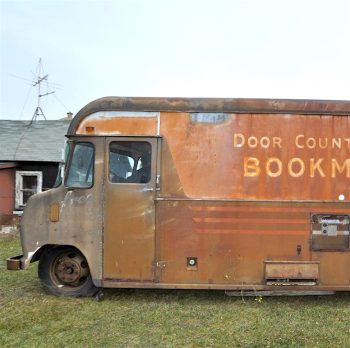
Door County Bookmobile before refurbishment, a bus-like vehicle with rusted exterior.

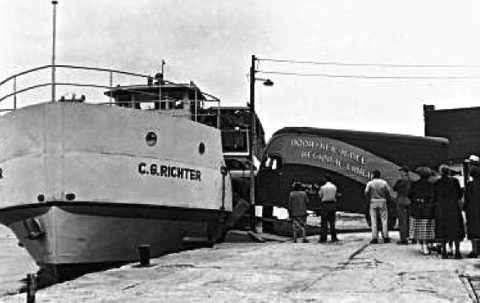
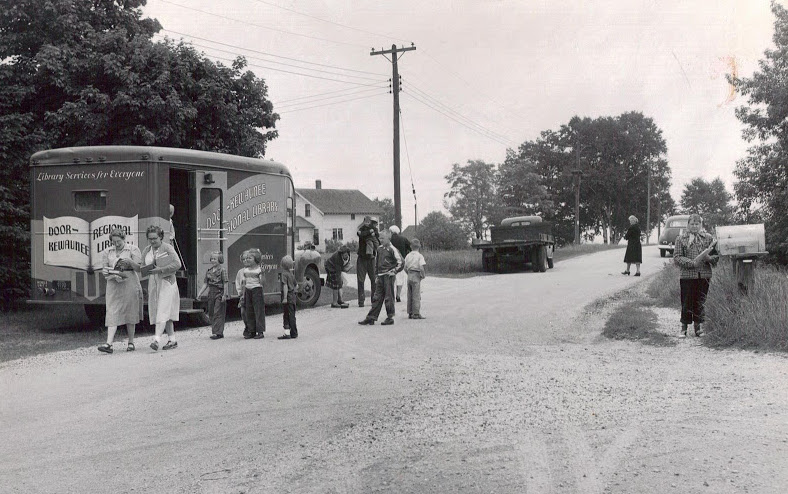
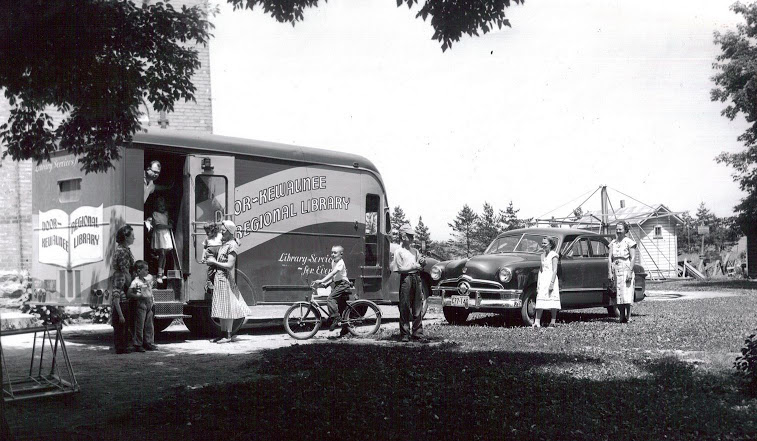
The Door County Bookmobile was the rural public library. In 1950 when the Door-Kewaunee Regional Library Demonstration first brought bookmobiles to the Door Peninsula, nearly 23% of Wisconsinites did not have access to a free library. With many remote towns and islands, a low overall population, poor transportation, and low literacy rates, the Door Peninsula offered an opportunity to test the bookmobile model for extending rural library services.  During the Demonstration period, libraries in Door and Kewaunee Counties saw a 160% increase in circulation, and most of this came from books borrowed by rural schoolchildren and women.  After a referendum in 1952, Door County continued the program on its own.

The bookmobile became an important tool connecting rural communities in Wisconsin to each other and to the rest of the state. The bookmobile was also an extension of the rural schools. It provided popular novels, classics and children’s stories and books in English as well as several native languages, agricultural magazines, do it yourself manuals for farmers and homemakers, and books for those interested in business. Inspired by the Wisconsin Idea, the creators of the Door County Bookmobile referred the bookmobile program as “the Idea in action.” Its goal was to help bridge the literacy gap in rural Wisconsin and build cooperation with and among the people of the region.

The post World War II  boom, expansion of the suburbs and the Library Services Act all helped increase demand for mobile library service across the United States. This created a niche industry for those who specialized in designing and manufacturing custom vehicles. A few companies took advantage of the opportunity and began the custom design of bookmobiles. The Door County Bookmobile was designed by the king of the bookmobile manufacturing industry, the Gerstenslager Company of Wooster, Ohio. Already a maker of fire trucks, mobile x-ray vans, television units and even the Oscar Meyer Weinermobile, they were well-suited to occupy this new niche.  Soon the company held a near monopoly on bookmobiles, enjoying 90% of the market.

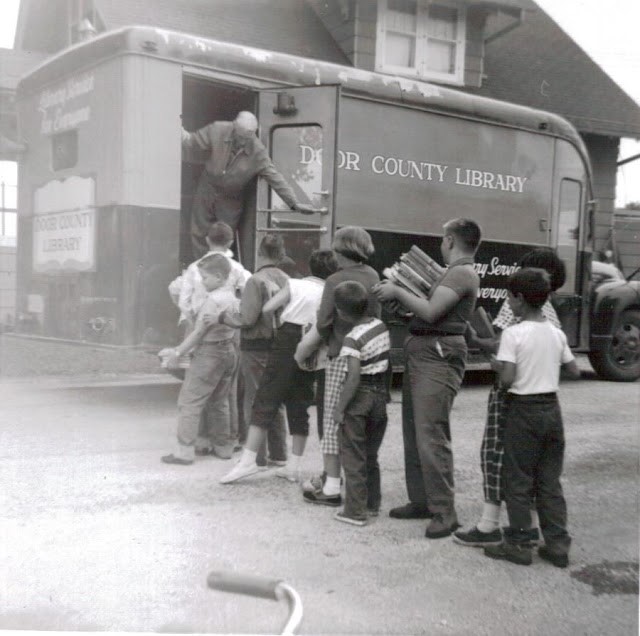
Children in Door Country line up to visit the bookmobile
Children in Door Country line up to visit the bookmobile. Image courtesy of the Egg Harbor Historical Society.

Their success was due to quality, craftsmanship and a well-designed national advertising tour in 1949 to unveil their pioneer bookmobile model. Each Gerstenslager bookmobile was custom-built and painted according to the needs of the individual library. The original Door County Bookmobile was built in 1950, but it was worn-out by 1967.  This model was its replacement. It was built by the Gerstenslager Company in 1964.

According to the Gerstenslager Company, the Door County Bookmobile model was classified as a Medium Bookmobile that could hold 1500-2500 volumes of books. It had an interior space 16 feet long and 7 feet in width; and an interior height of 6 feet 6 inches. The roof was an all-steel turret-type with two skylights to let in natural light. Two service doors on the right side of the vehicle allowed visitors to enter at the front and exit through the back. The cab compartment had two bucket seats, one for the driver and one for a helper, both seats were adjustable and reversible.

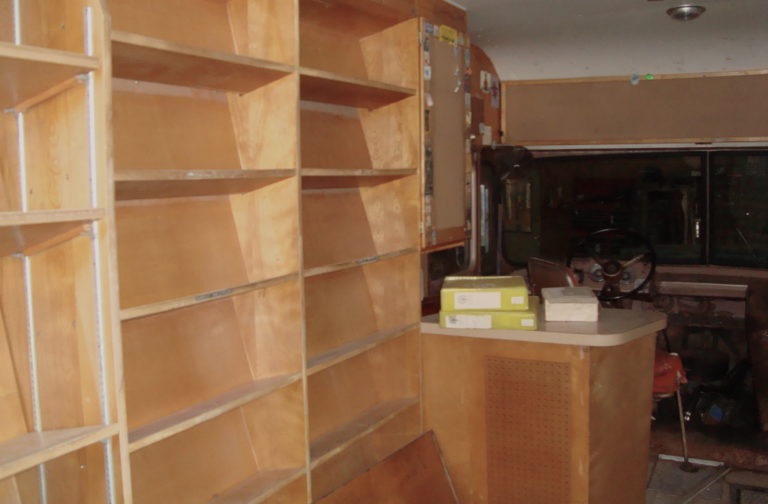
Inside the bookmobile, fluorescent fixtures provided lighting and the interior shelving was carefully designed using wood and steel shelving installed according to ALA standards. Each shelf was pitched at an angle and covered with rubber mats to keep books in place. The bookmobile included special sections with magazine racks, space for children’s books and oversize books, and a clothes closet in the left rear corner. A record cabinet, built beneath the rear window, had shelves to carry a supply of record albums. The top of the cabinet provided space for a record player. The appliance outlet at the rear of the vehicle provided an electrical connection for this purpose. And of course the necessary charge-out desk sits was behind the driver’s seat was covered with battleship linoleum to match the floor.

Written by Julie Hein, November 2017.

The interior of the Door County Bookmobile, including tilted shelves and the driver’s seat.
The interior of the Door County Bookmobile, including tilted shelves and the driver’s seat. Image courtesy of Julie Hein.

Sources:

Christine Pawley, “Blood and Thunder on the Bookmobile: American Public Libraries and the Construction of ‘the Reader,’ 1950-1995” in T. Augst & K. Carpenter, Institutions of ReadingThe Social Life of Libraries in the United States (Amherst: University of Massachusetts Press, 2007), 264-282.

Christine Pawley, Reading Places: Literacy, Democracy, and the Public Library in Cold War America (Amherst: University of Massachusetts Press, 2010).

Door County Library Memorandum, August 4th 1989.

Door County Advocate, December 3rd 1974.

Congressional Record– House (81st Congress 2nd session) 6 (3) March 9, 1950, 3129.

University of Illinois Library School Occasional Papers, Number Nine (April, 1950) “Basic Bookmobile Specifications.”

Updates:

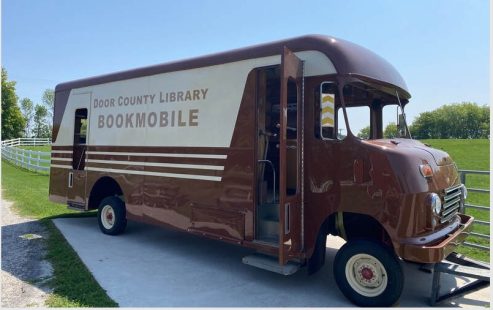
Since this essay was initially published, the Door County Bookmobile has been restored. It once again serves communities throughout Door County.

Refurbished Door County Book Mobile.

Egg Harbor Historical Society

This object is part of the Egg Harbor Historical Society Collection. Research for this object essay and its related stories was supported by the Egg Harbor Historical Society in Egg Harbor, Wisconsin.

Essay by Julie Hein
Produced for Wisconsin Life by Jane Genske

In 1950 when the Door-Kewaunee Regional Library Demonstration first brought bookmobiles to the Door Peninsula, nearly 23% of Wisconsinites did not have access to a free library. With many remote towns and islands, a low overall population, poor transportation, and low literacy rates, the Door Peninsula offered an opportunity to test the bookmobile model for extending rural library services.

Listen below to the segment from Wisconsin Public Radio’s Wisconsin Life.

Maureen McCollum:
Bookmobiles have long dotted Wisconsin’s roadways and parking lots. The state has a history of bringing books and movies to the people living anywhere from the Wisconsin Dells to Green Bay, the historic Door County bookmobile is one of the many items included in the Wisconsin 101, project which tells the state’s history through objects. Jane Genske, went to learn more about the role that bookmobiles play in our communities.

Jane Genske:
On a hot summer day on the north side of Madison, families shuffle in and out of the dream bus. It’s a bookmobile with bright cartoons painted on the outside.

Amy Winkleman:
This is a public library on wheels. So we have books, we have DVDs, we have CDs, we have audio books.

Jane Genske:
That’s Amy Winkelman, a librarian on the dream bus.

Amy Winkleman:
The idea is to bring library service to people that may otherwise, for whatever reason, have trouble getting to a library branch. So we built the top with his information. For his part, this is a big outreach project. We we want everyone to know that. We want them to be able to be able to use that public library service.

Jane Genske:
The bus can hold around 2500 books on its specially tilted shelves so they don’t fall off. The librarians are sure to stock the appropriate books for each of the stops in Madison and Sun Prairie, readers can find anything from foreign language materials to children’s books, plus the librarians take special requests. It’s a really fun way to get people excited about library service. The Dream bus is one of the many bookmobiles in Wisconsin. The state has a rich history of bookmobiles serving communities, especially in rural places like Door County.

The Door County bookmobile was a traveling public library that brought an array of books to the peninsula in the 1950s only the area’s wealthy families had large book collections, or those living near larger cities, like Sturgeon Bay had access to books. Students in rural schools were underperforming in reading and writing. Farmers worked all day at the expense of reading time. Many schoolhouses in Door County only had about 15 books on their shelves. Michaela Kraft is an intern at the Egg Harbor Historical Society. She has been researching the function of the bookmobile and its legacy for Door County today.

Michaela Kraft:
So the bookmobile actually was founded out of a need here in Door County, especially for rural readers,

Jane Genske:
The state funded the bookmobile in Door County and Kewaunee county in the 1950s. It was then up to the residents to decide if they wanted to continue funding it with tax dollars.

Michaela Kraft:
And then in 1952 they voted Kewaunee and Door County, and only Door County kept the bookmobile service.

Jane Genske:
This led to increased literacy scores for children living in the area.

Michaela Kraft:
It was actually instrumental in a lot of the older generation now loving reading.

Jane Genske:
The bookmobile would travel all over the peninsula. It stopped at churches, schoolhouses and street corners. For many children and adults, it was a chance to learn anything from new languages, to farming to home improvement tips.

Michaela Kraft:
The school children would look forward to the bookmobile because it would come once a week and they could choose anything.

Jane Genske:
The bookmobile brought excitement and curiosity to Door County. It opened the world to small communities who otherwise wouldn’t know what was going on beyond the peninsula.

Michaela Kraft:
I think before the bookmobile, a lot of children, especially, weren’t even aware of print culture or the opportunities that they could discover outside of their county, because they were so exceedingly rural. And there were a lot of immigrants who a lot of times, wouldn’t even speak English outside the home, even, so they would only have that experience of the outside world through reading.

Jane Genske:
In addition to increased literacy scores and eye opening experiences for isolated residents, it also provided a sense of interconnectedness amongst the scattered communities in Door County, much like the bookmobiles continue to do today.

Maureen McCollum:
That story about bookmobiles came from Jane Gensky, a UW Madison student working on an internship for Wisconsin Life and Wisconsin 101 which tells the history of the state through objects. Wisconsin Life is a co-production of Wisconsin Public Radio and Wisconsin Public Television in partnership with the Wisconsin Humanities Council. Additional support comes from Lowell and Mary Peterson of Appleton. Find more Wisconsin Life at wisconsinlife.org and on Facebook. I’m Maureen McCollum.