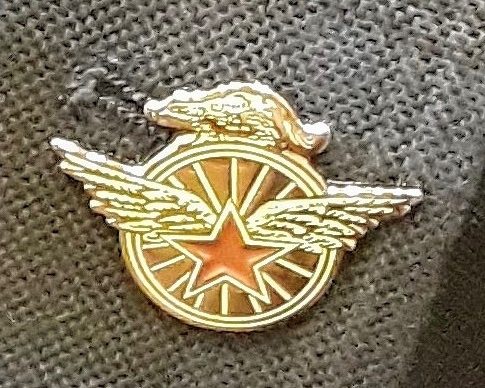

This brass and enamel pin was given to members of the Badger Wheelmen Club of Milwaukee. The design mimics the club’s logo of a winged, five-pointed star set atop a spoked bicycle wheel with the figure of a badger above. The imagery was characteristic of many bicycle clubs of the time, as many similar logos feature bicycle wheels and wings, though the inclusion of the badger was specific to the Badger Wheelmen. Owning and wearing the Badger Wheelmen pin was an honor and privilege, as it marked the wearer’s association with the exclusive Milwaukee club. Cycling clubs, such as the Badger Wheelmen were organized to promote bicycling as a respectable and worthwhile leisure pursuit, and the group advocated for better conditions for cyclists and promoted bicycle athletics by sponsoring group rides and bicycle races.
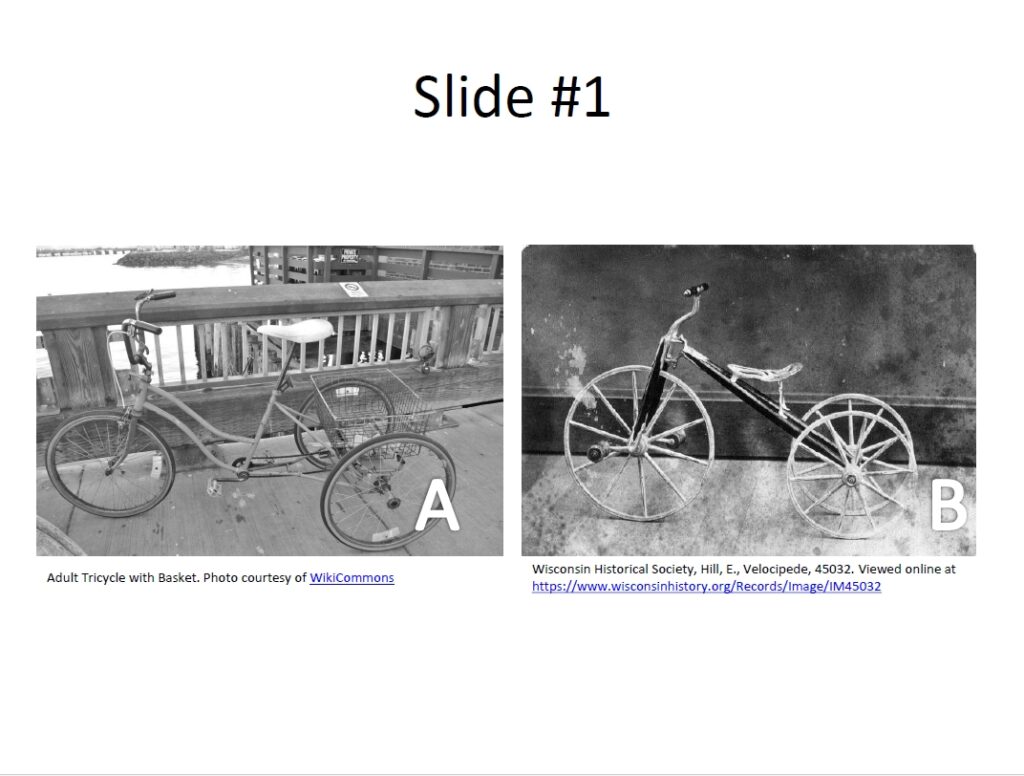
In 1879, Racine organized the state’s first high-wheel bicycle ride. High-wheel bicycles were distinguished by their design—having one larger wheel in front and a smaller wheel in back, and the pedals were located on the front axle. Because of this design the high-wheeler was largely gender-exclusive, as to propel the vehicle one’s legs had to stride the front wheel, which required the rider to be wearing pants rather than skirts; and in Victorian culture it was generally taboo for women to be seen in public wearing pants.
This would change, though, with the development of safety bicycles in the late 1880s, which used smaller wheels which moved the seat (and rider) closer to the ground—making it easier and safer to stop. American safety bicycles also commonly utilized the chain-drive system, which shifted the propulsion from the front to the rear wheel. Safety bicycle frames could also be modified to lower the top tube nearer the pedals to accommodate skirts.
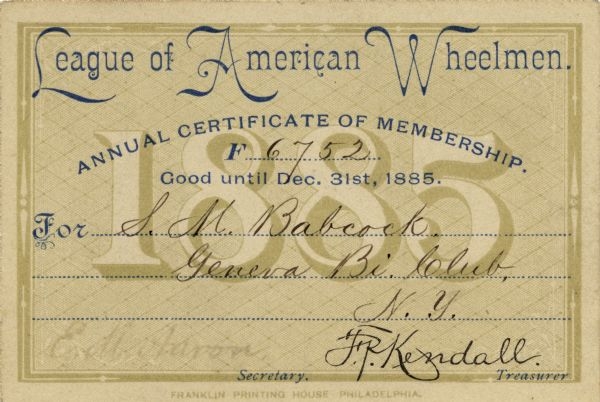
Following the Racine high-wheel bicycle ride, cycling became very popular throughout the state. The League of American Wheelmen (LAW) was founded in Newport, Rhode Island in May of 1880, and soon after it became a national organization as local cyclists founded divisions around the country. Their main drive was the promotion of the Good Roads Movement, to improve conditions for riders in the countryside. Other local cycling advocacy clubs were founded as well, like the Milwaukee-based Badger Wheelmen, whose gentlemen’s clubhouse was at the corner of Wells and 22nd Street. Clubs like these were, almost as a rule, restrictive in their membership to protect the interest in cycling as a middle- and upper-class recreational pursuit. As a result, through most of the 1880s and into the 1890s, bicycling remained a leisure past-time for the elite. However, the increased manufacture and lower cost of safety bicycles encouraged women, children, and non-white riders. Backlash was swift, and by the mid-1890s, the LAW placed implicit (and sometimes formal) bans on African American and women’s participation in their organization, which remained in effect until the original organization dissolved in 1902.
The Badger Wheelmen encouraged increased membership within the middle- and upper-class by extending membership to children, but was slow in allowing Black or female members. Enrollment in the club required invitation and two sponsors. If a man received these, then they would need to pay 50¢ to join, and a $6.00 annual membership fee.
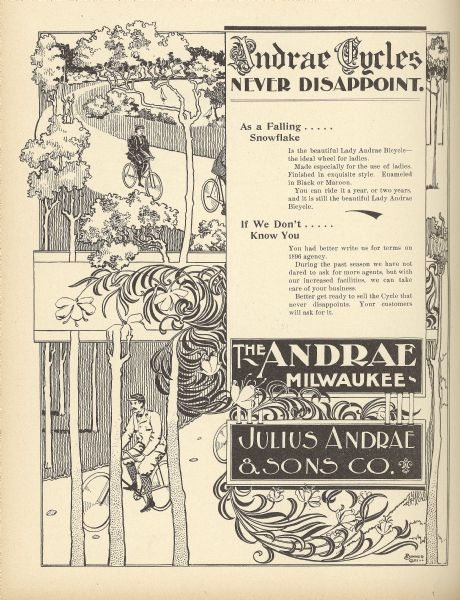
One of the Badger Wheelmen’s most notable member families was the Andraes. Julius Andrae was the owner of Julius Andrea & Sons, which produced (amongst other things) bicycles. In 1895, the Badger Wheelman sponsored a bicycle race for the grand prize of an Andrae bicycle, a notable prize as Andrae was considered the finest bicycle available at the time. Many of the racers rode Andrae bicycles, and perhaps the best advertising for their brand was Julius’s son Terry “The Flying Badger” Andrae, a heavily decorated cyclist who competed in races throughout the Midwest. Otto Dorner was the national chair of the LAW’s road improvement committee, which led the national charge in the Good Roads Movement.
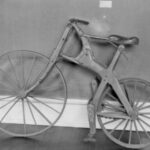
Thanks to cycling clubs such as the Badger Wheelmen, people across the state caught wheel fever! More bicycle shops, like the Sterling Cycle Shops in Kenosha, were founded to meet the growing demand. Some people even built their own bikes from wood and farm equipment. Though the advent of the automobile in the early twentieth century surpassed the bicycle craze of the nineteenth, the lasting effects of an increased public interest in touring and improved roads continued to benefit the people of Wisconsin, and the organization and structure of bicycle clubs served as a model for later automobile and driving associations.
Written by Joy Huntington in November 2018, edited and expanded in July 2025.


SOURCES
Jesse J. Gant and Nicholas J. Hoffman, “Bicycling,” Encyclopedia of Milwaukee. https://emke.uwm.edu/entry/bicycling/
Jesse J. Gant and Nicholas J. Hoffman, Wheel Fever: How Wisconsin Became a Great Bicycling State. Madison: Wisconsin Historical Society Press, 2013.
Margaret Guroff, “American Drivers Have Bicyclists to Thank for a Smooth Ride to Work,” Smithsonian Magazine, 12 September 2016. https://www.smithsonianmag.com/travel/american-drivers-thank-bicyclists-180960399/
Nick Hoffman and Jesse Gant, “Bicycling in the 19th century,” Recollection Wisconsin, 12 October 2012. https://recollectionwisconsin.org/bicycling
League of American Bicyclists, “Equity and Our History,” https://bikeleague.org/about/equity-and-history/
James Longhurst, Bike Battles: A History of Sharing the American Road. Seattle: University of Washington Press, 2015.
Ideas for Educators:
This object was highlighted as part of the Old World Wisconsin Mini Tour.
Click on the document links (at right) to download the ‘Badger Wheelmen Pin Lesson Plan’ the ‘Bikes Past and Present Activity’ and the ‘Bikes and Laws Activity’ prepared by Joy Huntington.
Old World Wisconsin
This object is part of the Wisconsin Historical Society Collection at Old World Wisconsin. Research for this object essay and its educational materials was supported by Old World Wisconsin in Eagle, Wisconsin.
RELATED STORIES

Wisconsin Road Conditions
The 1890s Bicycle Craze in Wisconsin

OBJECT HISTORY: Sterling Safety Bicycle
Wisconsin Bicycle Tourism