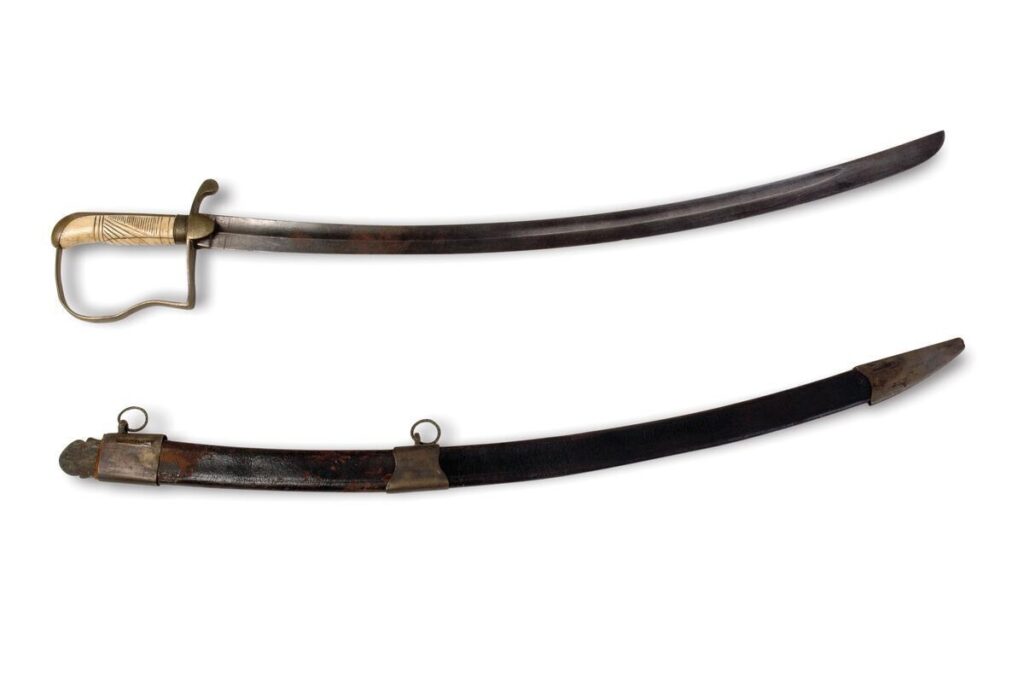
John Rountree’s officer’s sword is thirty and three-quarters inches long from tip to pommel with a 26-inch blade of curved steel. When you hold it, it is eerie to know that this sword might have been used in actual battle by John Rountree during the Black Hawk War —a war which played a significant role in the founding of Wisconsin and the further removal of Native Americans from their ancestral lands. Both an artifact of Rountree and the war he participated in, this sword is a visually striking piece of American military history. As with all historical objects, the story the sword communicates to today’s audience differs from those stories it may have told in the past; and while we may be captivated by this object in its presence, the feelings we take away from the encounter might strike a different tone.
Even two centuries after its creation, the craftsmanship of the blade is beautiful in its own way. The dull, dark metal, patinaed with age, mutedly reflects the light, all the way up to where it meets the elegantly curved hilt.
John Rountree's Officer Swoard and Scabbard. Wisconsin Historical Society, museum object #1947.750,a.
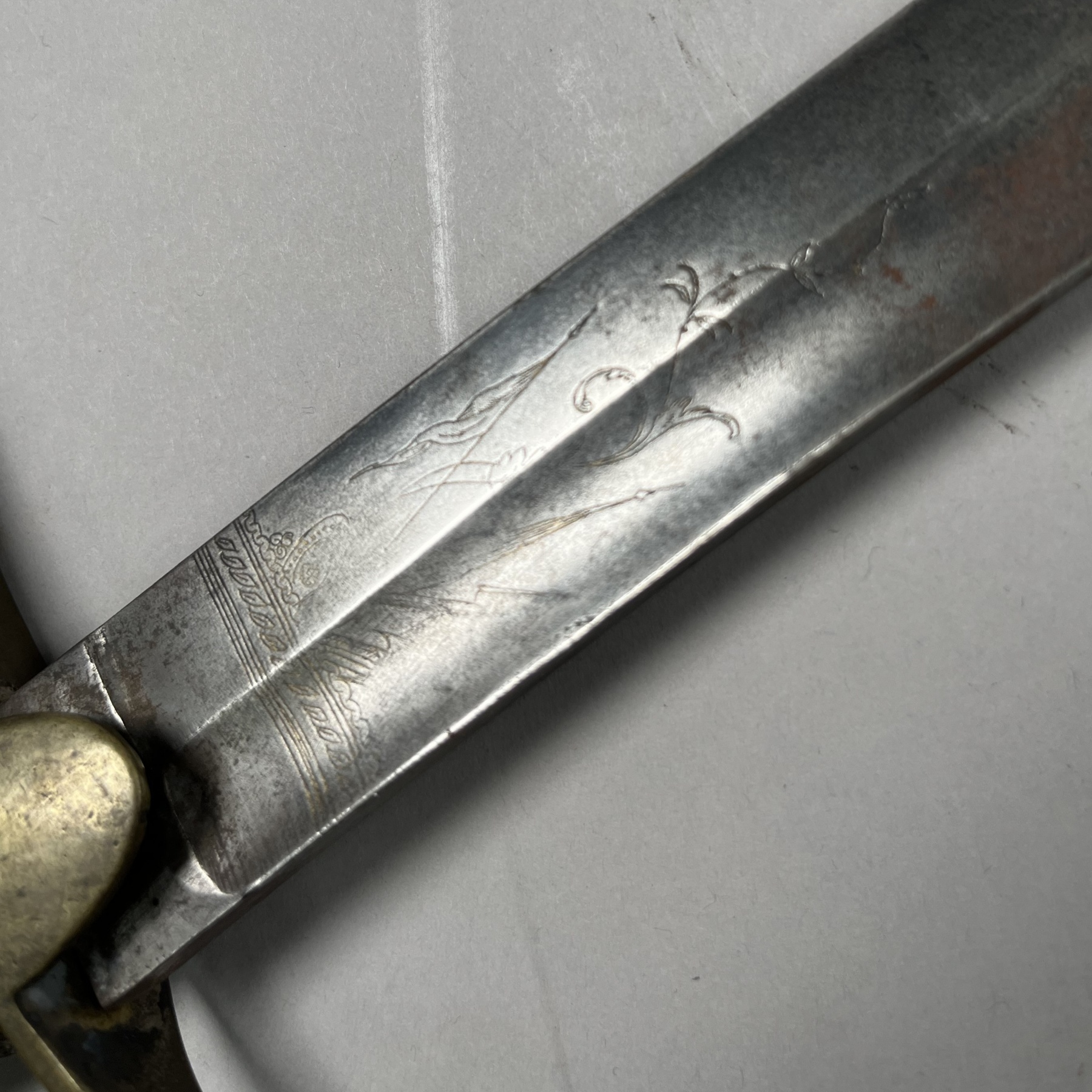
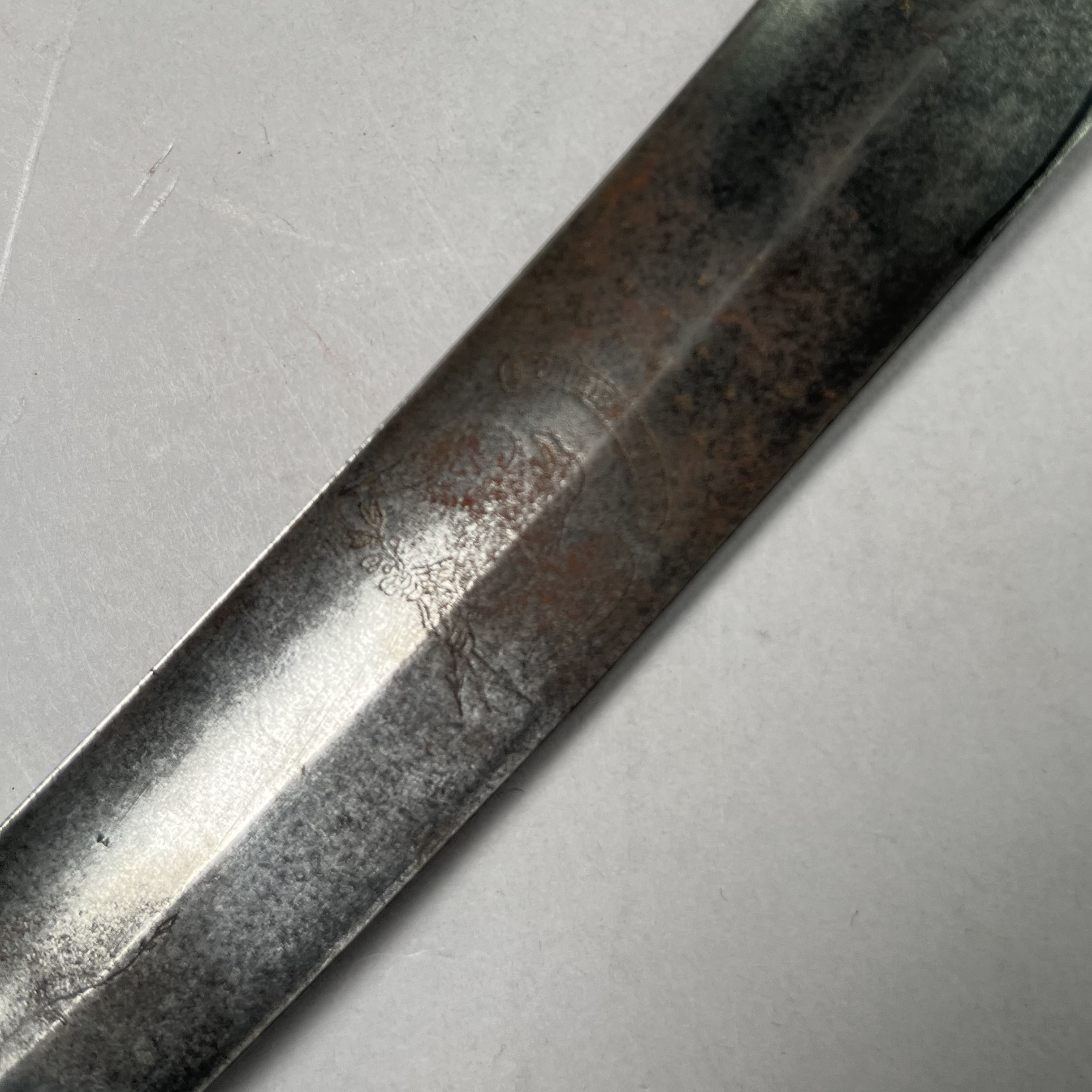
The eye is immediately drawn to the ivory carving on the handle of the sword. On further inspection, one will notice engraved decorative elements on the blade. These have been obscured by age and would have been a more prominent feature when the sword was in prime condition. On one side, the blade is engraved with an American eagle situated below the national motto of the United States, “E Pluribus Unum.” In addition, both sides are engraved with a design with crossed flags, crossed swords and daggers, and a floral spray.
Detail of the sword's blade showing engraved decorative elements of crossed flags, crossed swords, and floral spray. Photo by the author.
Detail of the sword's blade showing the engraving of the American eagle under a banner which reads "E Pluribus Unum." Photo by the author.
The sword is likely of German or French origin, and it is a tentative match for swords used in the United States in the period after the war of 1812 — meaning the engravings could have been added by Rountree after the fact. The sword is shorter and lighter than one might anticipate. This nimble design was characteristic of cavalry swords: the length and curved blade made it easier to pull from its scabbard from a saddle position, and the light weight allowed for the soldier to maneuver the piece from side to side during battle. Although they may simply indicate typical wear and tear accumulated during this sword’s long lifespan, the good number of chips on the edge of the blade indicate the sword may have been used in combat — marks that represent the bodies of fleeing Native American during one of several massacres that define the fighting of the Black Hawk War.
The sword is notable for its unique preservation, including, rarely, a still very much intact leather scabbard. The scabbard features two metal loops which would have been used to fasten the blade to a belt; as well as a “chape,” — like a metal cap that protects the tip of the blade from piercing through. At the top of the scabbard, on the metal “throat band” is an engraving that reads, “John Rountree, Black Hawk War, 1832.” In the height of its glory, when it was carried to war by Rountree in 1832, the metal of the sword would have been polished to a brilliant silver shine, and the blade would have been kept razor sharp — probably by one of the three enslaved persons who were kept in bondage by Rountree. The weapon in its prime would have been even more beautiful and would have held even more military allure than the weapon does in its present condition.
Once, this sword could have been presented in American history museums as an artifact of America’s triumphant expansion Westward, and Rountree could have been simply presented as a quintessential intrepid soldier of the American frontier. But the still unfolding post-colonial reckonings of the past few decades make the contemporary historical significance of the blade darker and more uncertain. In the present moment, it is hard to uncritically celebrate the beauty of the weapon without thinking of the suffering inflicted on Native peoples. However, whether to focus on the sword’s preservation, military allure, and craftsmanship, or whether to see it as part of this legacy is a decision for the viewer.
Written by John O’Brien, July 2025.
Wisconsin Historical Society
This object is part of the Wisconsin Historical Society collection in Madison, Wisconsin. Wisconsin History Museum Object #1947.750-a.