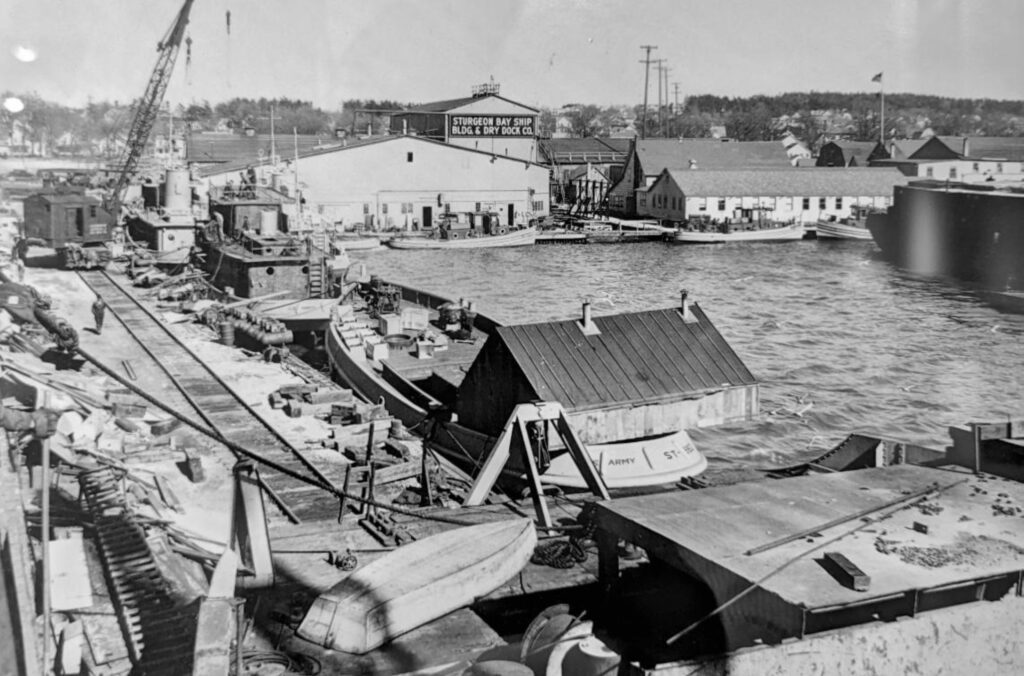
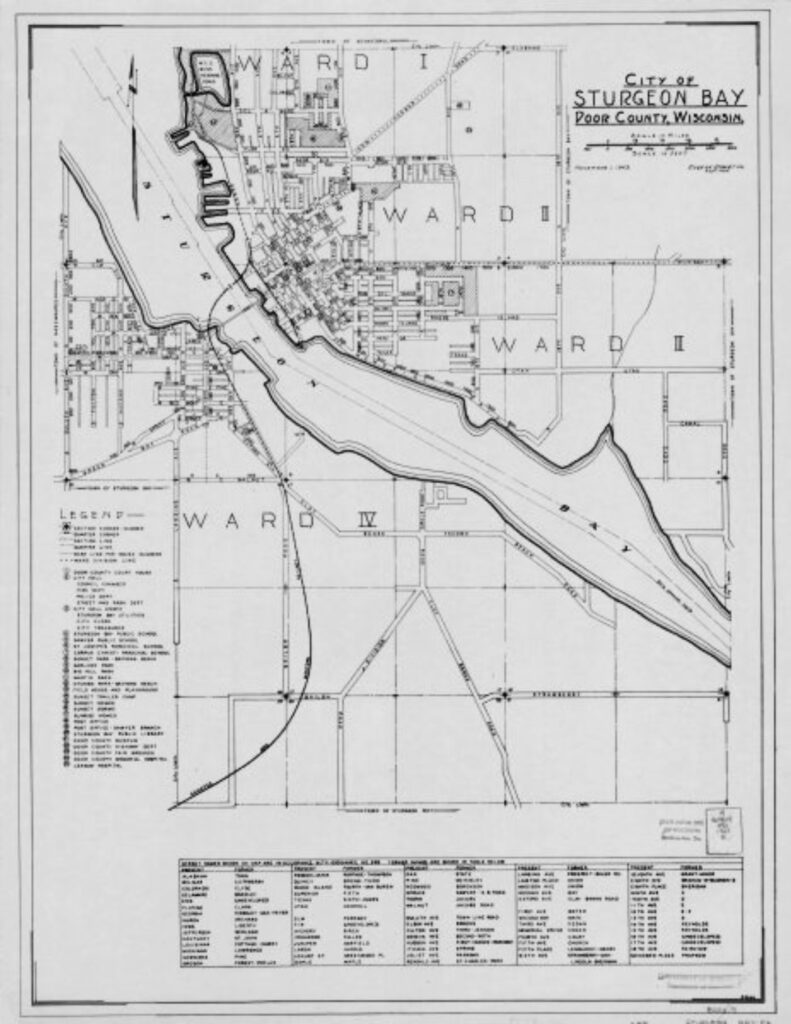
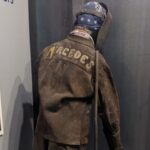
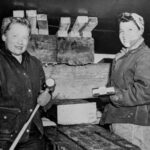
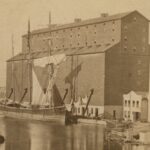
The Sturgeon Bay Ship Canal opened in 1881 to provide a sailing route through the Door Peninsula to both shorten the shipping distance between cities on Green Bay and Lake Michigan and to avoid the treacherous waters of the Porte des Mortes (or Death’s Door) strait between the northern end of the peninsula and Washington Island. Located at the center of the peninsula, and protected from rough waters by a natural bay, the city of Sturgeon Bay became a hub for wooden ship manufacturing, taking advantage of the natural resources supplied by the dense local forests. The most notable of these, the Sturgeon Bay Shipbuilding and Drydock Company, grew to become one of the largest Wisconsin contributors to the war effort during World War II, employing many hard-working individuals and helping to fulfill rising federal vessel demands one launch at a time. Though the economic focus of the Wisconsin peninsula shifted away from shipbuilding after the war, the legacy of its contribution to national efforts persists as part of the local identity.
Established in 1896 with a meager workforce of between twenty and thirty men, the Rieboldt and Wolter Company quickly became the foremost shipbuilding outfit in Sturgeon Bay and the most reputable shipyard on the Great Lakes for building wooden vessels, repairing older ships, and constructing dry docks. In 1917, historian Hjalmar Holand commented on the expertise of Rieboldt and Wolter, explaining, “Hundreds of vessels have here limped in lame and shabby, and after a few weeks’ treatment by expert mechanics have sailed off dapper and jauntily.”
Then, the Universal Shipbuilding Company and the Sturgeon Bay Dry Dock Company followed this outfit in the timeline of the Sturgeon Bay shipbuilding industry. Incorporated in 1916, Universal Shipbuilding conducted a general shipbuilding business for seven years; similarly, Sturgeon Bay Dry Dock manufactured and repaired boats from 1920 and onward. The development of these companies aligned with strategic federal initiatives led by President Woodrow Wilson to increase general military preparedness and achieve a top-ranking navy through the construction of many new ships during the first World War.
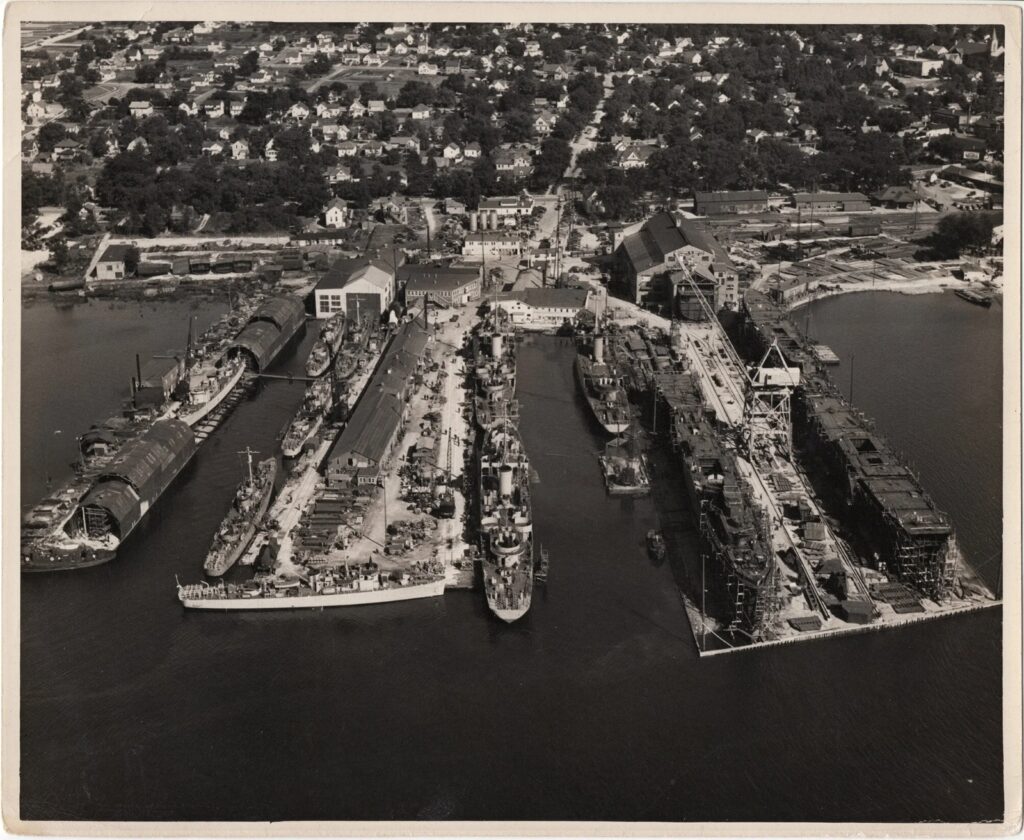
By January of 1926, eight years after World War I, the local corporation pair of Universal Shipbuilding and Sturgeon Bay Dry Dock merged to form the Sturgeon Bay Shipbuilding and Drydock Company. As a productive consolidation of its two predecessors, the new unified company functioned to build new ships, to repair old or damaged ships, and to erect, maintain, and operate dry docks. Notably, a shift from wooden to metal materials paralleled the company’s development, posing a solution to the epidemic of significant cracks and fractures in ligneous ships caused primarily by bombs at sea. This material transition required extensive remodeling throughout the process of shipyard production, including the replacement of wooden riveting with electric-arc welding, which proved itself to be a highly advantageous substitution. Shipbuilding processes rearranged to centralize around industrial welding, allowing for the creation of far stronger and faster vessels for the second World War.
During World War II, Sturgeon Bay Shipbuilding and Drydock Company manufactured and launched eighty-five steel vessels throughout the war years, contributing significantly to national maritime production numbers. In 1941, the dry dock launched four dredge tenders, which the United States Army used to clean and maintain harbor beds. The following year saw the production of eight distribution-box boats, which the Army’s Quartermaster Corps applied for the allocation of electrical power during mine-laying. While these ships remained within fifty to seventy feet in length, the company received contracts for larger vessels by 1942 and began manufacturing eleven retrieving vessels. Spanning over one hundred fifty feet long, these ships eventually transported supplies and personnel for the Air Force. By 1943, the Sturgeon Bay Shipbuilding and Drydock Company began producing fifteen-hundred-foot cargo ships for the Quartermaster Corps, fourteen supply vessels of one hundred seventy-six feet in length for the Transportation Corps, and ten forty-five-foot motor tenders. With such a massive-scale output and the significant demand quantity, the shipbuilding industry fueled the Sturgeon Bay economy.
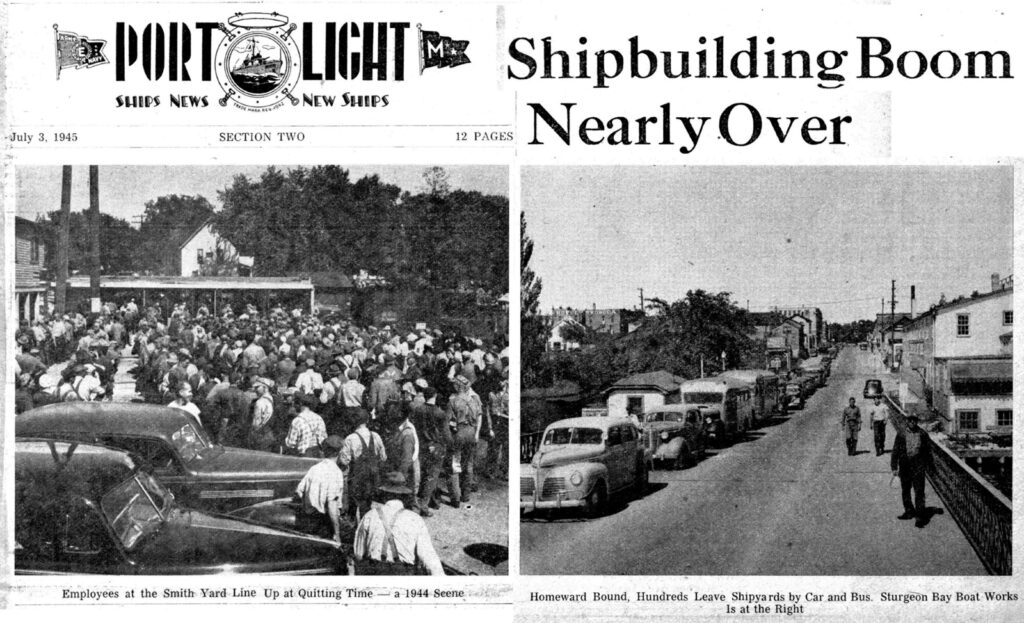
The maritime history of Sturgeon Bay culminated after twenty-seven years with the shipyard production efforts of World War II. In the calm after the war, the shipbuilding boom quickly died off, workers dispersed or returned home, and the economic focus of Door County shifted to its other agricultural industries, which eventually led to an influx of tourism that remains in the modern day. By 1968, the Sturgeon Bay Shipbuilding and Drydock Company sold into Bay Shipbuilding, a massive merger of several shipbuilding companies that made use of the canal through the bay. The following year saw the establishment of the Door County Maritime Museum, which served to memorialize all of Sturgeon Bay’s renowned industrial history and the commendable individuals who labored to maintain it. Today, visitors can engulf themselves in the maritime charm of the city’s shipbuilding heritage and observe clear signs of its substantial wartime contributions throughout the welcoming peninsula.
Written by Serena LaLuzerne, June 2025.
Sources
Christopher B. Havern Sr., “Woodrow Wilson, World War I, and Freedom of the Seas.” Naval History and Heritage Command (website), 30 October 2020. https://www.history.navy.mil/content/history/nhhc/browse-by-topic/wars-conflicts-and-operations/world-war-i/history/ww1-freedom-of-seas.html
Hjalmar R. Holand, History of Door County, Wisconsin, The County Beautiful. Chicago: S. J. Clarke Publishing Company, 1917. https://content.wisconsinhistory.org/digital/collection/wch/id/33199.
Charles I. Martin, History of Door County, Wisconsin. Sturgeon Bay, WI: Expositor Job Print, 1881. https://content.wisconsinhistory.org/digital/collection/wch/id/29579.
“Our History.” Destination Door County. Accessed 31 October 2023. https://www.doorcounty.com/discover/our-history.
Herb Reynolds, “Sturgeon Bay Shipbuilding and Dry Dock Company.” Sturgeon Bay, WI: Door County Maritime Museum, 2023.
Sturgeon Bay Shipbuilding and Dry Dock Company. “Sturgeon Bay Shipbuilding and Dry Dock Company Records, 1916-1941.” Wisconsin Historical Society Division of Library, Archives, and Museum Collections. University of Wisconsin–Green Bay, July 14, 1965.
Christopher James Tassava, “Weak Seams: Controversy over Welding Theory and Practice in American Shipyards, 1938-1946.” History and Technology 19, no. 2 (2003): 87–108.
United States House of Representatives, “Report on Sturgeon Bay and Lake Michigan Ship Canal, Wisconsin,” 62nd Congress, Third Session, Document 1312. https://www.govinfo.gov/content/pkg/SERIALSET-06394_00_00-022-1382-0000/pdf/SERIALSET-06394_00_00-022-1382-0000.pdf
Wisconsin Historical Society, “Sturgeon Bay, Wisconsin.” Historical Essays, July 27, 2012. https://www.wisconsinhistory.org/Records/Article/CS2457.