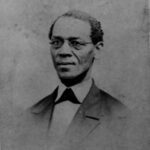
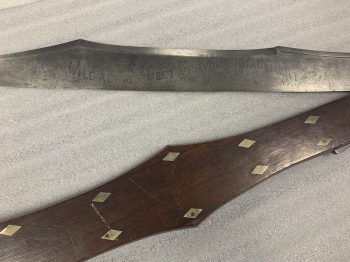
Measuring over six feet in length and weighing thirty-two pounds, this gigantic folding knife belonged to Wisconsin representative John Fox “Bowie Knife” Potter who was famous as a dedicated abolitionist and infamous for his willingness to use physical force on the United States House floor of the against pro-slavery southern representatives. The knife features a rosewood and brass handle and a blade with engravings on either side. One side reads, “Presented to John F. Potter of Wisconsin by the Republicans of Missouri 1860” and the other, “Will Always Meet a Pyror Engagement”–a reference to the incident that inspired the gift. It was manufactured in Wallingford, Connecticut by the New England Cutlery Company but was kept at Potter’s home in East Troy, Wisconsin until his death in 1899.
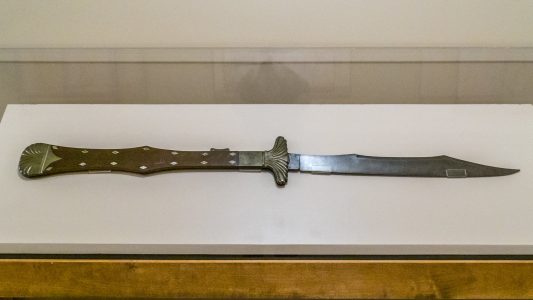
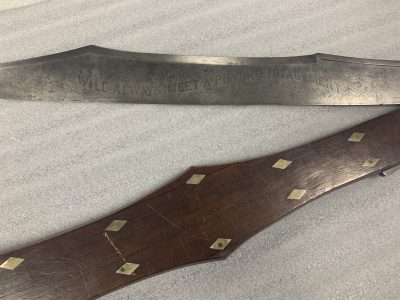
The knife was presented to Potter in Chicago at the Republican Convention of 1860 in reference to a particularly infamous incident that Potter had been involved in with a fellow representative. Earlier that year, Representative Owen Lovejoy, a Republican from Illinois had given a speech on the U.S. House floor in which he denounced slavery and southern slaveholders, a stance which particularly angered the chamber’s southern members. Democrat Representative Roger Pryor of Virginia, sprang up and demanded that Lovejoy desist, at which point Republican John Potter rose to defend Lovejoy and his abolitionist arguments. Insults were hurled, but the Speaker of the House and the sergeant-at-arms were able to seemingly stave off further incident. After the official record of the debates was distributed a few days later, Representative Pryor noticed that the transcript was incongruent with his memories of the event, and demanded that remarks that Potter had not made at the time be struck from the official congressional record. He insisted that Potter had “doctored” the record in his favor, and Potter admitted that he asked for the remark to be added after the fact, but only because it had originally been omitted.

Pyror, who perceived the implication that he was being dishonest as an attack on his honor, challenged Potter to a duel to “demand the satisfaction usual among gentlemen.” As late as the nineteenth century, dueling had been a common form of settling disputes of honor, but had been outlawed in many states (including Wisconsin) and Potter likewise despised the practice. Neither wishing to decline the challenge and forfeit his own honor, nor wishing to take part in what he saw as barbarism, Potter had to devise a clever solution. He decided to accept the proposed duel and, as it was customary for the challenged party to choose the weapons, he took this opportunity to make a political statement, proclaiming they would fight with bowie knives—a weapon just as barbarous as the practice of dueling—to expose the folly in settling disputes in such an inhumane manner. Pyror’s second rejected these terms calling them “vulgar, barbarous, and inhuman.” Pryor, who had fled the state to avoid arrest for dueling, also objected to Potter’s terms but still tried to continue the challenge. Unfortunately (or fortunately) for him, Potter had been arrested and briefly detained for disturbing the peace, so the feud never came to any bloodshed. The incident proved to be a humiliation to Pryor on a national scale, and it painted Potter as a northern hero for exposing the foolishness of southern bravado. Potter began to receive bowie knives in the mail from his supporters in reference to his now infamous response to Pryor, spurring the dedication of the “monster knife” to him at the convention.
After narrowly avoiding this duel, Potter continued to use his position in the House to advocate against slavery, particularly with an interest in preventing the horrific and barbaric institution from spreading to new states. He continued to serve as a U.S. Representative until 1862 when he was defeated by the Democrat James Brown over the issue of Civil War. (Potter was against the war, a position that was evidently not as popular with voters as Brown’s pro-war stance won him the seat.) After losing this election, Potter served for three years as the Consul General to the British Provinces in North America, before returning to his estate “Lake Side Manor” in East Troy, Wisconsin to resume his private legal practice. He remained at his home until his death in 1899 but he continues to be remembered as someone willing to fight, sometimes literally, for the rights of all.
Written by Maria Serrano, October 2024.

Sources
PGB, “The ‘Monster Knife’ of John Fox Potter.” Curators’ Favorites, Wisconsin Historical Society. April 7, 2005. https://www.wisconsinhistory.org/Records/Article/CS2802. (Accessed April 2024).
Randall R. Garczynski, Let It Demonstrate: Bowie Knife Potter, Godfather of Phantoms. Mineral Point, Wisc: Little Creek Press, 2014.
“John Fox Potter’s Death Recalls ‘Bowie-Knife’ Incident in Thirty-Sixth Congress,” The New York Times, May 21, 1899.
M. Ouaife, “When Bowie Knife Potter ‘Scalped’ a Fire-Eater” The Milwaukee Journal, November 27, 1921. Reproduced online by the Wisconsin Historical Society. https://www.wisconsinhistory.org/Records/Newspaper/BA4321. (Accessed April 2024).
“The Potter-Pryor Duel,” The Wisconsin Magazine of History 2(4). June 1919. 449-452. https://content.wisconsinhistory.org/digital/collection/wmh/id/1287
Potter’s Lake Protection and Rehabilitation District, “History,” Potters Lake (website). Accessed December 1, 2023. https://www.potterslake.org/history
L.E.S. “Historic Bowie Knife Episode Marks Slavery Debate in Congress,” The Milwaukee Journal, November 7, 1920. Reproduced online by the Wisconsin Historical Society. https://www.wisconsinhistory.org/Records/Newspaper/BA2699. (Accessed April 2024).
Wisconsin Historical Society, “Potter, John Fox 1817 – 1899: Republican Congressman and American Diplomat.” Historical Essays, Wisconsin Historical Society. August 3, 2012. https://www.wisconsinhistory.org/Records/Article/CS2489. (Accessed April 2024).

Wisconsin Historical Society
This object is part of the Wisconsin Historical Society collection in Madison, Wisconsin Historical Museum Object #1957.1122.
Produced for Wisconsin Life by Gil Halstead
On April 5, 1860, as tensions over slavery grew, Wisconsin Congressman John F. Potter was challenged to a duel by a pro-slavery colleague from Virginia. The argument led to a 31-pound, 6-foot-long folding knife and a story that made Potter famous.
Listen below to the segment from Wisconsin Public Radio’s Wisconsin Life.
It was April 5th of 1860. Just a year before the Civil War would begin. On the floor of Congress, Illinois Congressman Owen Lovejoy was gesticulating wildly as he delivered a blistering attack on slavery. Nearly a century later, historian William Hesseltine described the scene:
“Up jumped Virginia Congressman Roger Pryor and shook his fist in Lovejoy’s face while other pro slavery congressmen shouted out derisive comments like “Negro thief!” and “The meanest negro in the south is your superior.” Republicans on the other side of the aisle rose in defence of Lovejoy’s abolitionist speech. Among them Wisconsin’s John Fox Potter of Walworth county, his great black moustache bristling.”
The debate ended peacefully as Potter remembers it with Lovejoy finishing his speech from Clerk’s desk.
A few days later, Roger Pryor challenged John Fox Potter to a duel. He claimed Potter had tampered with the Congressional record by inserting language that was not part of the debate. Here’s how Potter remembered it in an interview he gave to the Chicago Tribune in 1896:
“That afternoon I got a note from Pryor challenging me to meet him in mortal combat. I believe that Pryor’s object in proposing a duel was to obtain an easy and cheap renown in his own section. I thought after all that had taken place it was not my duty to decline to fight. But I was not a good shot with a pistol and I did not purpose to have any hair trigger business. I proposed to bring the combat down to the first principles of human butchery. Therefore I accepted his challenge with the stipulation the weapons should be bowie knives and the encounter should take place in a closed room and the fight to go on till one or the other of us fell. Pryor refused on the grounds that the terms were barbarous.’ I replied that the custom of duelling itself was barbarous and inhuman.”
The duel never happened. District of Columbia police arrested both men to keep the peace and then released them on bond after tempers had cooled. But the event, according to historian Hesseltine, made Potter famous for his willingness to defy southern braggadocio.
“From all parts of the country, bowie knives came to Representative Potter,”wrote Hesseltine. “And the following month, the Missouri delegation to the Republican convention in Chicago carried a 7-foot bowie knife to present to the redoubtable champion of northern honour.”
To add insult to the already injured southern pride, the knife was inscribed with a pun that made fun of the Virginian Roger Pryor. It read, “to John Fox Potter who will always meet a Pryor engagement.” Potter was re-elected to another term and was known for the rest of his life as “Bowie Knife Potter.” Journalists dubbed it the “Monster knife” and it became a powerful symbol of northern opposition to slavery in the 1860s.
“We all felt that the time had come for some Northern man to lay aside this scruples and strike one blow that would convince the south that we were not to be bullied any longer,“ remembered Potter.
A year later the duel with bowie knives that never happened erupted into real shooting match with the outbreak of the Civil War.
RELATED STORIES
The Development of Progressive Politics in Wisconsin from Abolition into the Twentieth Century