Captain Israel Williams founded Williams Bay, Wisconsin, in 1835. Williams and his two sons originally traveled to Wisconsin from their Massachusetts home to look for good farmland. Williams Bay was later named in honor of Captain Williams.

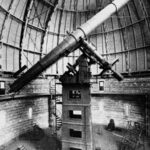
Until 1890, only a few families lived in Williams Bay. Instead, the land was used for road and railroad development. The first railroad came to Williams Bay in 1888. Shortly after, more people came to settle and the area became a vacation spot for wealthy Chicagoans. By 1894, Williams Bay contained a residential subdivision, school, church and several businesses. That same year, construction of Yerkes Observatory and the 40-inch refracting telescope began.

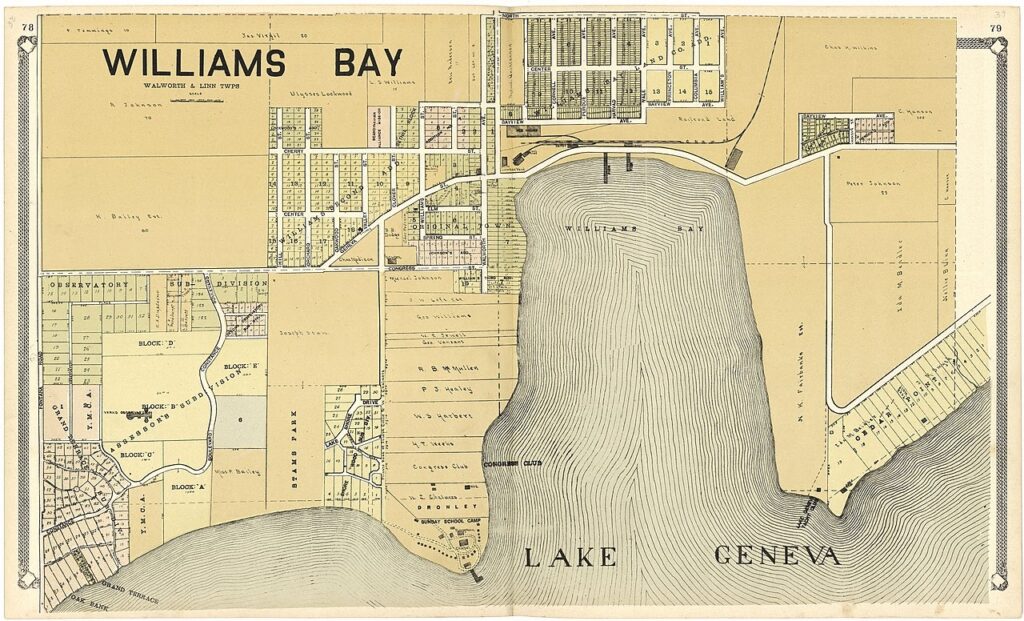
Map of the Village of Williams Bay from 1907, at the northern edge of Lake Geneva.
Map of Williams Bay from the 1907 Standard Atlas of Walworth County, Wisconsin. The Yerkes Observatory is situated at the lower left.

George Hale chose Williams Bay over 27 other locations, including Lake Forest, Illinois and Pasadena, California, to be the home of Yerkes Observatory for many reasons. First, Williams Bay was 80 miles away from Chicago. So, the location was outside of Chicago’s “smoke zone,” but was also still considered commuter distance. Because Williams Bay was a popular location for Illinois vacationers, the university built summer homes on part of the land to rent out to produce the astronomers’ salaries. Also, the land for the observatory was two miles away from a railroad station and 30 miles away from Lake Michigan, producing easy accessibility for people all over the world. Lastly, the observatory was built on the tallest hill, 1,050 feet above sea level, within a 100-mile radius of Chicago, which meant the telescope would observe the sky more clearly because higher air has fewer currents and less moisture.

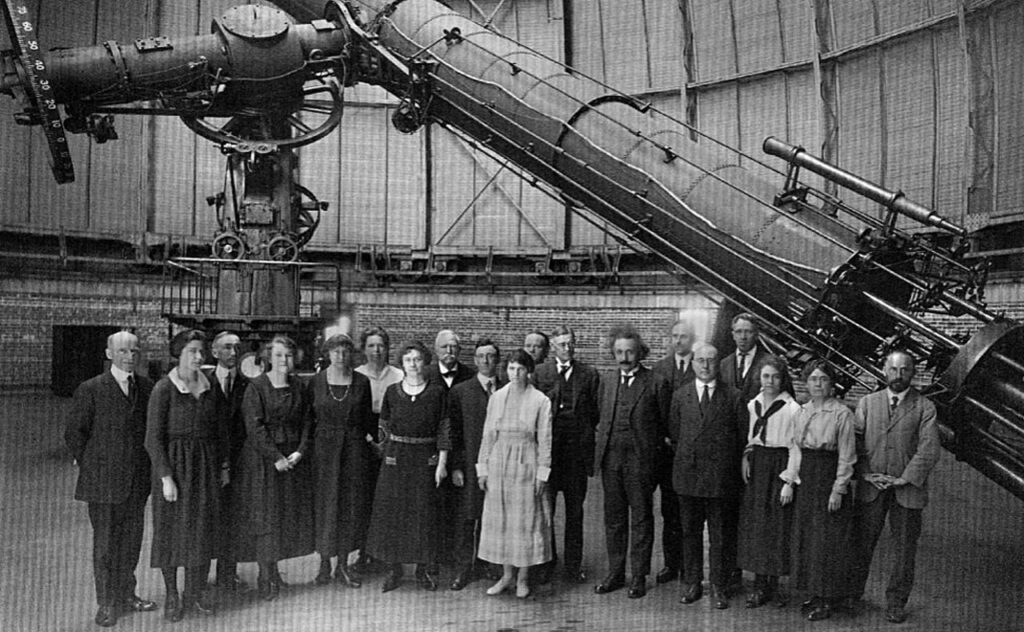
A group portrait inside the Yerkes Observatory featuring Albert Einstein and members of the observatory staff.
Photograph taken of the Yerkes Observatory staff in front of the 40-inch Refractor on the occasion of Albert Einstein's visit in 1921. Photo from Yerkes Observatory via Wikimedia Commons.

The one issue with building Yerkes Observatory in Williams Bay was the closeness of Lake Geneva. Hale worried that the lake would worsen observing conditions from larger amounts of fog and wind. Hale talked with astronomers from the University of Wisconsin-Madison whose observatory was similarly placed on Lake Mendota. The UW-Madison astronomers assured Hale that Lake Geneva would not be a problem because the surface area of the lake was not large enough to produce atmospheric disturbances.

From 1894-1897, Yerkes Observatory was constructed in Williams Bay on a plot of land that was donated to the University of Chicago. Finally, on October 31, 1897, Yerkes Observatory and the 40-inch refracting telescope opened to begin work that was thought by Hale to “make any work done at other observatories to be rendered useless.”

Written by Kelsey Corrigan, December 2014.

SOURCES

“Atomic Explosion of Star Discovered by Observatory,” The Waukesha Freeman. January 9, 1946.

Richard Berendzen, Man Discovers the Galaxies. New York: Columbia University Press, 1984.

Bruce Bond, “A Celebration of Light: Yerkes in Perspective,” Astronomy Magazine, December 1982.

Rose Cour, “Observatory at Lake Geneva a Popular Spot,” The Chicago Tribune, 31 August 1938.

Michael Ference, “The Graphic Laboratory of Popular Science,” The Chicago Tribune, 31 October 1943.

George Hale, National Academies and the Progress of Research. Lancaster: New Era Printing Company, 1915.

James Lattis. Personal Interview. 4 November 2014.

Peter Susalla and James Lattis, Wisconsin at the Frontiers of Astronomy. Madison: University of Wisconsin-Madison Department of Astronomy, 2009.

Donald Osterbrock, Pauper & Prince: Ritchey, Hale, & Big American Telescopes. Tucson: University of Arizona Press, 1993.

Donald Osterbrock, Yerkes Observatory, 1892-1950. Chicago: University of Chicago Press, 1997.

“Two Kinds of Telescopes,” Astronomy GCSE. http://www.astronomygcse.co.uk.

Deborah Warner, Alvan Clark & Sons Artists in Optics. Washington, D.C.: Smithsonian Institution Press, 1968.

“What the Yerkes Telescope Promises to Science,” The Chicago Tribune. 12 September 1897.

Helen Wright, The Legacy of George Ellery Hale. Cambridge: MIT Press, 1972.

“Yerkes Observatory Repairs,” The Chicago Tribune, 2 September 1897.