
OBJECT HISTORY: Wilson Place Door
The Wilson Place Mansion front door was crafted at the turn of the twentieth century, likely by a well-known Arts and Crafts Movement blacksmith named Thomas F. Googerty. Wilson Place Mansion was the home of James Huff Stout, a lumber baron, longtime state senator, and philanthropist.

The Arts and Crafts Movement
Founded in Great Britain by author, designer, and political activist William Morris (1834-1893), the movement spread to the United States by the late 1880s. The Arts and Crafts Movement combined nostalgia, higher standards of workmanship for consumer goods, and concern over the poor working conditions and pollution of the Industrial Revolution.
The Stout Institute and Educational Innovation
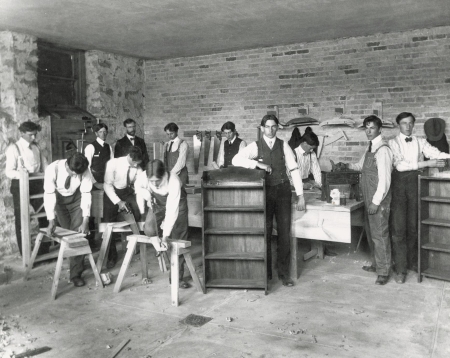
At the Stout Institute, James Huff Stout supported a new approach to formal education in which students learned not only from textbooks, but also engaged in hands-on activities to gain advanced technical skills. In 1891, Stout established new programs offering technical education for boys and domestic science for girls through the Menomonie Public Schools.